

Most textile buyers evaluate fabric by touch, color, and price. Yet one invisible factor determines whether a printed cotton bedsheet still looks vibrant after 50 washes or fades into a dull shadow after a dozen cycles: the printing chemistry.
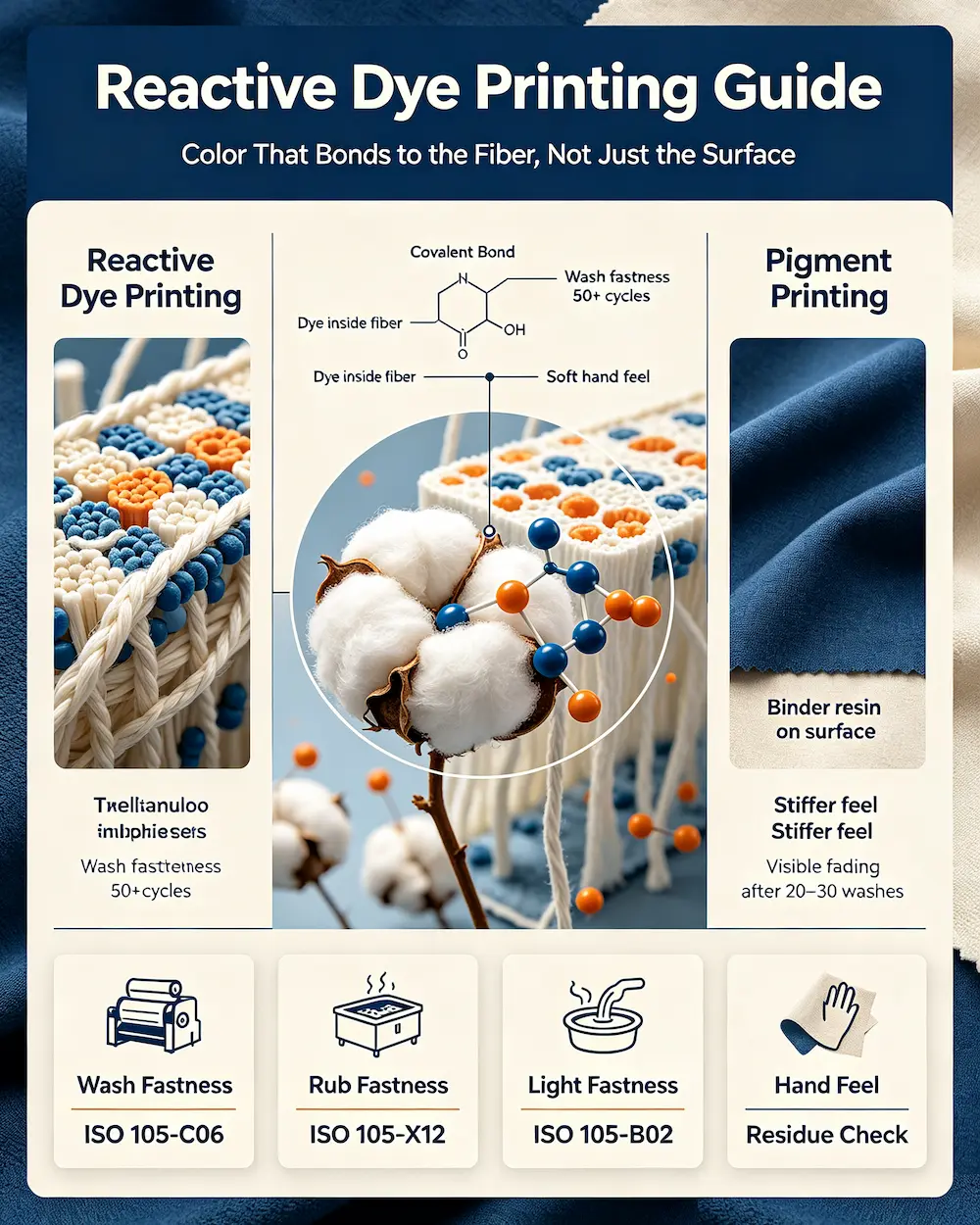
Reactive dye printing stands as the premium method for cellulose fibers like cotton, linen, and viscose. Unlike pigment printing — which glues color onto the fabric surface — reactive dyes form a permanent chemical bond with the fiber itself. This distinction shapes everything from wash durability to hand feel to the retail price your customers will pay.
As a textile importer or wholesale buyer, you need to understand this technology not as an academic topic but as a sourcing decision tool. This guide explains how reactive dye printing works, how it compares to alternatives, and when it delivers enough value to justify its higher cost.
What Is Reactive Dye Printing?
Reactive dye printing uses dyes that contain a chemically “reactive” group — typically a chlorotriazine or vinyl sulfone structure. When manufacturers apply these dyes to cotton or other cellulose fabrics under alkaline conditions and heat, the reactive group forms a covalent bond with the hydroxyl (-OH) groups that naturally exist along cellulose molecular chains.
In practical terms, a covalent bond is the strongest type of chemical connection in organic chemistry — the same kind that holds water molecules together. Once a reactive dye molecule locks into this bond, the color essentially becomes part of the fabric. Water, detergent, and friction cannot dislodge it.
This mechanism explains the three defining advantages of reactive printing:
- Wash fastness: Reactive-printed cotton retains its color through 50+ industrial wash cycles with minimal fading. Pigment prints typically show visible degradation after 20–30 washes.
- Rub fastness: Because the dye sits inside the fiber rather than on its surface, reactive prints resist crocking — the color transfer that occurs when fabric rubs against skin or other materials.
- Hand feel: Since no binder or resin coats the fabric surface, reactive-printed cotton feels identical to unprinted cotton of the same base cloth. Buyers of premium garments and luxury bedding consistently prefer this natural softness.
How the Reactive Dye Printing Process Works
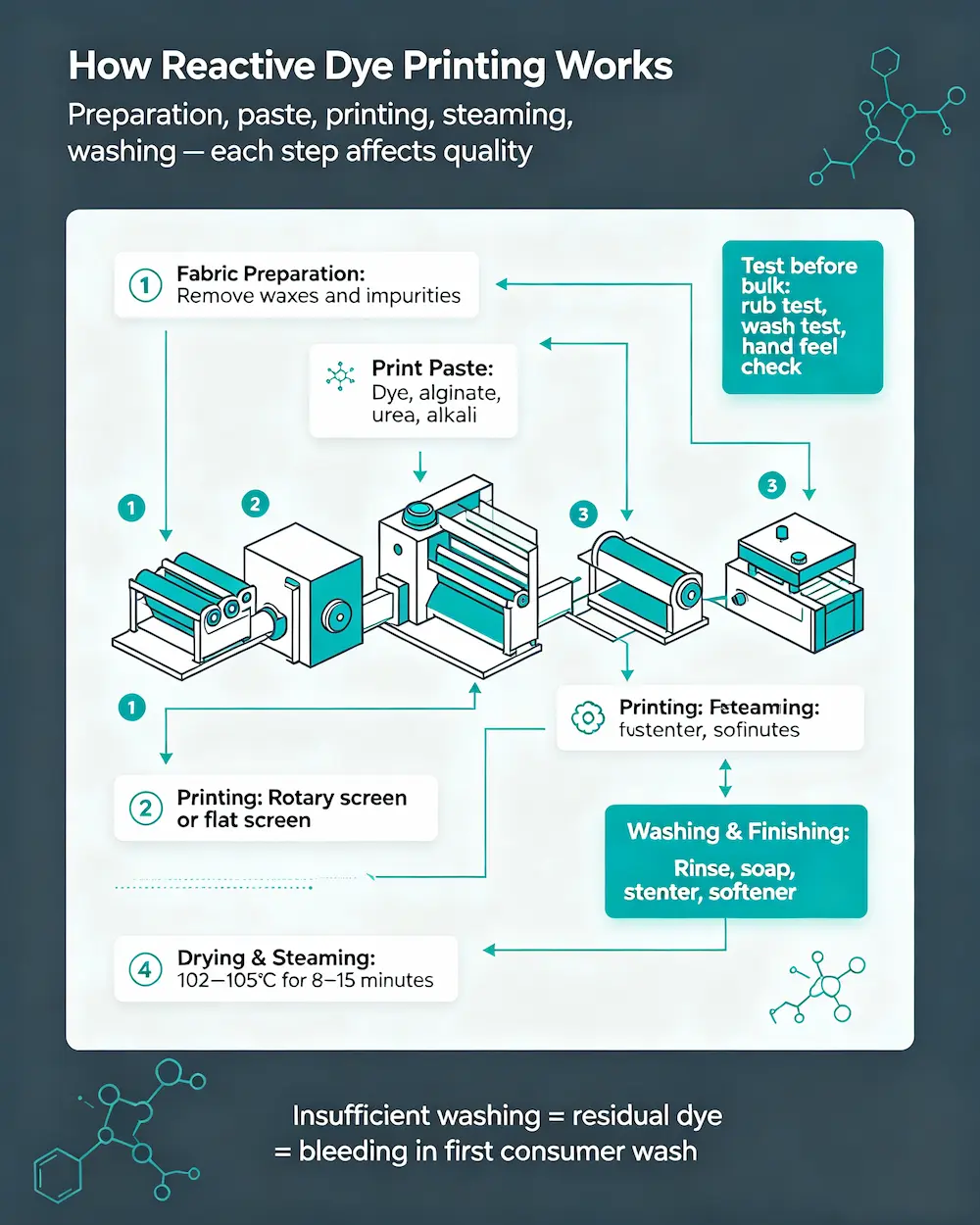
Reactive dye printing involves more steps than pigment printing — and each step adds cost, time, and quality. Understanding this sequence helps you evaluate supplier capabilities and identify potential quality risks.
Stage 1: Fabric Preparation
The cotton fabric first passes through scouring, bleaching, and mercerizing to remove natural waxes, oils, and impurities. Clean, uniform fiber surfaces absorb dye evenly — skipping or rushing this stage produces patchy color and inconsistent results. The mill then treats the fabric with an alkaline solution and urea, which prepare the fibers for the upcoming chemical reaction.
Stage 2: Print Paste Preparation
The print paste combines four essential components:
- Reactive dye — the colorant
- Sodium alginate thickener — a seaweed-derived polymer that controls viscosity and keeps pattern edges sharp
- Urea — holds moisture during steaming to swell the cellulose fibers
- Alkali — the catalyst that triggers the covalent bond formation
The thickener plays an especially critical role. It must deliver crisp print definition during application, then wash out completely during the final rinse. Any residue left behind creates a stiff, uncomfortable fabric.
Stage 3: Printing
The prepared paste transfers onto the fabric through rotary screen printing (fast, continuous patterns) or flat screen printing (precision, shorter runs). At Weifang Tianhong Textile, we operate 9 rotary screen machines and 2 flat screen machines across two dedicated reactive dye printing lines, delivering 20 million meters of annual output.
Stage 4: Drying and Fixation
After printing, the fabric dries at moderate temperatures (80–100°C) to remove water without prematurely triggering the dye-fiber reaction. Then the critical step: steaming. The fabric enters a sealed chamber with saturated steam at 102–105°C for 8–15 minutes. Inside this environment, the urea absorbs moisture and swells the cellulose, the alkali activates the reactive dye groups, and the covalent bonds form rapidly between dye molecules and fiber hydroxyl groups. Our long-ring steaming machines at Tianhong ensure uniform steam penetration across the full fabric width for batch-to-batch color consistency.
Stage 5: Washing and Finishing
The final washing sequence matters as much as any previous step. A multi-stage process — cold rinse, hot soaping at 90–95°C, warm rinse, final cold rinse — removes all unfixed dye and thickener residue. The fabric then passes through a tensioning and setting machine (stenter) to restore dimensional stability and receive any softener or functional finish. Factories that shorten or skip any wash stage leave residual dye on the fabric, which will bleed during the consumer’s first wash. This single quality gap separates professional reactive printing operations from budget alternatives.
Reactive Dye Printing vs. Pigment Printing: A Buyer’s Decision Framework
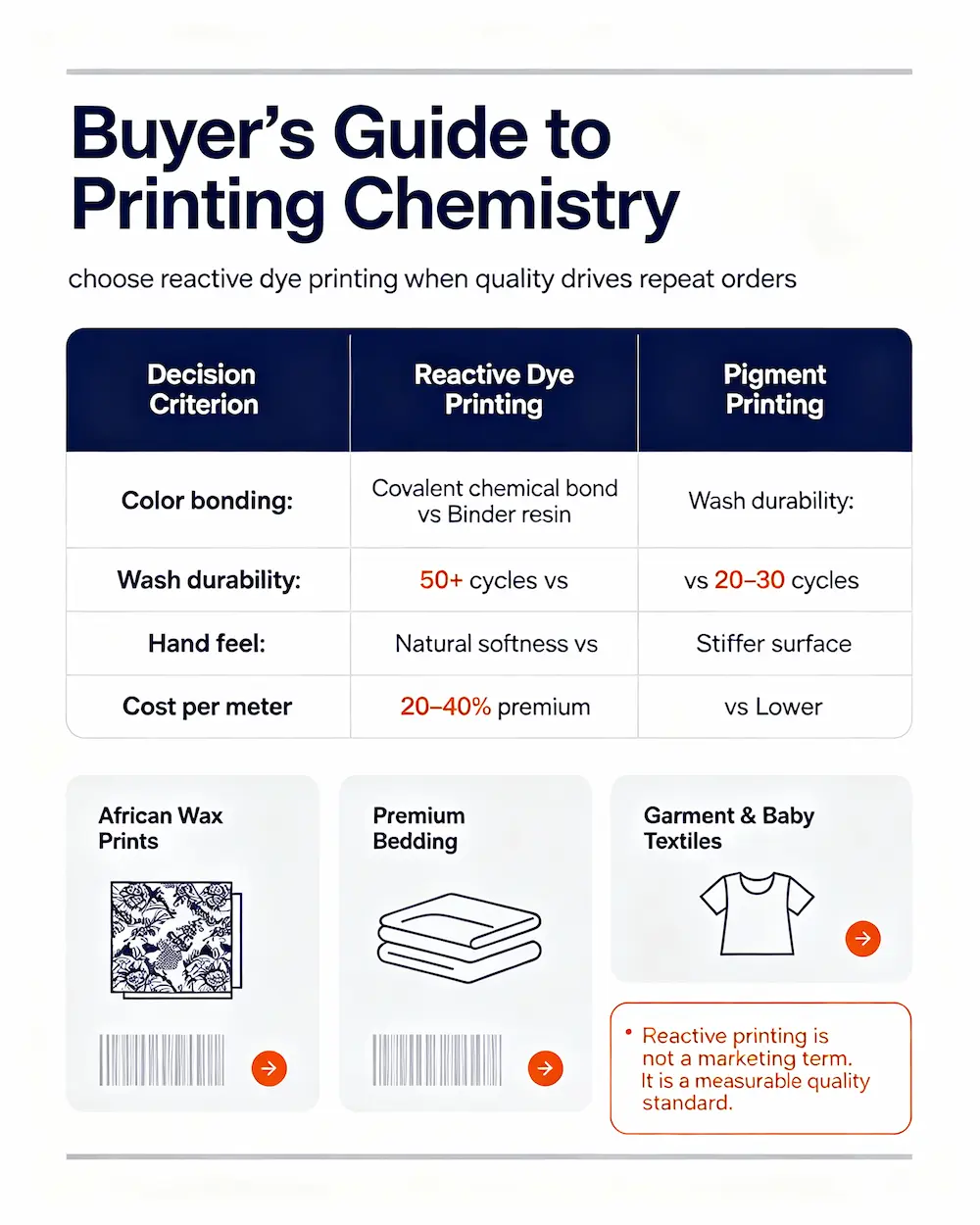
Rather than treating these as simply “better” or “worse,” frame the choice around your specific market position. The table below compares the two technologies across the criteria that matter for sourcing decisions:
The strategic question: If your customers return to buy again because the product lasts, reactive dye printing justifies its premium. If your business model depends on the lowest possible unit cost and your customers accept shorter product lifespans, pigment printing may serve your needs. Many successful importers use both — reactive for their flagship product lines and pigment for entry-level or promotional SKUs.
At Tianhong Textile, we maintain both technologies at industrial scale: 2 reactive dye lines producing 20 million meters annually for premium cotton applications, and 9 pigment lines delivering 90 million meters for volume-driven polyester markets. This dual capability means we match the right technology to your commercial strategy — not the other way around.
Which Products Benefit Most from Reactive Dye Printing?
Certain product categories see a disproportionate return on the reactive printing investment:
African Wax Prints: High-quality wax prints demand deep, vibrant colors and sharp pattern registration. West and Central African markets expect fabrics that maintain their brilliance through years of wear and washing. Reactive-printed cotton wax prints deliver this. Our premium African wax print collection uses exclusively reactive dyes on cotton for the color depth and fastness these markets require.
Premium Bedding Sets: Hotel chains and luxury retailers specify reactive-printed bedding because it survives the 50+ industrial wash cycles a commercial laundry demands. The soft hand feel also matters — guests notice coarse, stiff sheets immediately. Browse our polyester bedding sets and bed sheet fabrics, noting that reactive printing suits cotton-base products while our pigment lines handle polyester volume runs.
Garment Fabrics: Apparel worn against skin — shirts, dresses, children’s clothing — benefits from the zero-residue finish of reactive printing. The fabric breathes naturally, feels soft, and poses minimal skin irritation risk because the post-print washing removes all unfixed dye and chemicals.
Baby and Medical Textiles: These regulated segments demand the highest safety standards. Reactive-printed cotton, when properly washed, carries virtually no residual dye, making it the preferred choice for products that contact sensitive skin.
Quality Benchmarks Every Importer Should Know
When you receive fabric samples or inspect a shipment, focus on these measurable quality indicators rather than subjective impressions:
Wash Fastness (ISO 105-C06): This test washes a fabric swatch with standard detergent at 60°C alongside a multi-fiber witness strip. Technicians then rate both the color change of the printed fabric and the staining on the witness strip on a 1–5 scale. Demand Grade 4.0 minimum for commercial use. Premium products should achieve Grade 4.5–5.0.
Rub Fastness (ISO 105-X12): A dry cotton rubbing cloth moves back and forth over the printed surface under controlled pressure, followed by a wet cloth test. Rate the resulting stain on a 1–5 scale. Acceptable dry rub: Grade 4.0. Acceptable wet rub: Grade 3.0–3.5. Lower scores indicate inadequate post-print washing — a very common quality failure among low-cost suppliers.
Light Fastness (ISO 105-B02): Expose the printed fabric to a xenon arc lamp alongside Blue Wool standards, then rate fading on a 1–8 scale. For upholstery and curtain fabrics, target Grade 5.0 or higher. For apparel and bedding, Grade 4.0 serves as the minimum threshold.
Hand Feel Check: A reactive-printed area of cotton fabric should feel indistinguishable from an adjacent unprinted area of the same base cloth. Any stiffness or “boardy” sensation suggests thickener residue — a sign of insufficient washing that will also correlate with poor rub fastness.
You can learn more about fabric weight and quality metrics in our guide on bedding sets — fabric weight and thread count.
Environmental Management in Reactive Dye Printing
Reactive dye printing consumes more water and energy than pigment printing — a fact responsible buyers should acknowledge rather than ignore. However, modern facilities mitigate this through systematic environmental management:
- Wastewater treatment: On-site treatment stations process all washing effluent, removing hydrolyzed dye residues, alkali, and thickener degradation products before discharge.
- Heat recovery: Exhaust heat recovery systems capture thermal energy from hot wastewater and reuse it to pre-heat incoming fresh water, reducing overall energy consumption.
- High-fixation dyes: Modern bifunctional reactive dyes achieve fixation rates exceeding 85%, which means less dye hydrolyzes and wastes per production run — lowering both dye cost and effluent load.
- Emission control: Desulfurization, denitrification, and dust removal systems for thermal oil furnaces address air quality, while solid waste collection systems handle fabric trimmings and packaging waste.
At Tianhong Textile, our integrated manufacturing campus operates all these systems under one roof, providing the compliance documentation buyers need for markets governed by EU REACH, ZDHC, and OEKO-TEX Standard 100 regulations.
Frequently Asked Questions
Q: What is the difference between reactive dyeing and reactive printing?
Reactive dyeing produces solid, all-over color by immersing the entire fabric in a dye bath. Reactive printing applies dye selectively to create patterns, designs, and motifs on the fabric surface. Both processes use the same chemical bonding mechanism, but printing requires thickeners for pattern control and uses far less water since only the printed areas carry dye.
Q: Can you use reactive dyes on polyester fabric?
No. Reactive dyes bond specifically with hydroxyl (-OH) groups in cellulose fibers (cotton, linen, viscose) and amino (-NH2) groups in protein fibers (silk, wool). Polyester lacks these functional groups entirely. For polyester, manufacturers use disperse dyes, which work through a completely different mechanism — diffusion into the fiber under high heat and pressure. If your product is 100% polyester, discuss pigment or disperse printing options with your supplier. Read our cotton vs. polyester African wax prints comparison for more on fiber selection.
Q: How many washes can reactive-printed fabric survive?
A properly processed reactive-printed cotton fabric with a wash fastness rating of Grade 4.0–5.0 will show no visible fading after 50+ standard home wash cycles at 40–60°C. Compared to pigment prints at the same wash cycle count, reactive prints typically outperform by a factor of 2–3x in accelerated wash testing.
Q: Why does reactive-printed cotton feel softer than pigment-printed cotton?
Pigment printing applies a binder resin that forms a thin polymer film on the fabric surface to hold pigment particles in place. This film stiffens the fabric and reduces breathability. Reactive printing leaves zero surface residue — the sodium alginate thickener used during printing washes out completely during the final rinse. The fabric retains its original softness and natural drape.
Q: How much more does reactive dye printing cost?
Reactive printing typically costs 20–40% more per meter than pigment printing. The premium comes from additional processing steps (steaming, multi-stage washing), higher dye cost, and greater energy and water consumption. However, brands in the mid-to-premium market segments usually recover this cost difference through higher retail pricing and lower return rates. For a deeper look at textile import economics, see our guide on how much it costs to import textiles from China.
Q: How do I verify that fabric is reactive-printed rather than pigment-printed?
Three practical field tests: (1) Rub test — rub the printed area firmly 20 times with a damp white cloth. Reactive prints show minimal to no color transfer; pigment prints typically leave visible color on the cloth. (2) Hand feel comparison — feel the printed area versus an unprinted area of the same fabric. Reactive prints feel identical; pigment prints feel stiffer or smoother. (3) Lab test — request ISO 105-C06 wash fastness results from your supplier. A Grade 4.0 or higher result strongly indicates reactive printing.
Q: Does reactive dye printing work for African wax print designs?
Yes — in fact, premium African wax prints almost exclusively use reactive dyes on cotton. The deep, saturated colors and sharp pattern definition that define quality wax prints require the color penetration and fastness that only reactive printing provides. Browse our African wax print fabric collection for reactive-printed options. You can also read our technical comparison of real wax print vs. imitation wax print.
Q: What MOQ applies to reactive-printed fabric orders?
At Tianhong Textile, our reactive dye printing lines target mid-to-large volume orders — typically 2,000–5,000 meters per design, depending on color count and pattern complexity. For smaller test orders, we recommend sampling through our pigment printing lines first, then scaling up to reactive for bulk production. Contact our trade team for a customized quotation based on your specific requirements.
Conclusion
Reactive dye printing is not a marketing term — it describes a measurable chemical process that produces tangible quality differences. The covalent bond between dye and fiber translates directly into longer product lifespan, better customer satisfaction, and stronger brand reputation in competitive textile markets.
For importers and wholesalers serving markets where quality drives repeat purchases — premium bedding retailers, African wax print distributors, garment brands — reactive printing is not an upgrade option. It is the baseline that defines your product’s competitive position.
Weifang Tianhong Textile operates reactive and pigment printing lines under one roof across a 162,373-square-meter integrated manufacturing campus. With 20 million meters of annual reactive capacity and 90 million meters of pigment capacity, we help buyers match the right technology to their market reality — whether that means premium reactive-printed cotton or cost-optimized pigment polyester.
Contact our trade team to discuss your next order or request fabric swatches for quality evaluation.