

If you source African print fabric for wholesale or distribution, you face one critical decision early on: real wax print or imitation wax print. The two products look similar at a glance, but they differ dramatically in how manufacturers produce them, how they perform, and how much they cost. Importers who understand these differences can match the right product to the right market — and protect their margins in the process.
This article breaks down the real wax print vs imitation wax print comparison across four dimensions: manufacturing process, visual and physical characteristics, pricing logic, and target market fit.
What Is Real Wax Print?
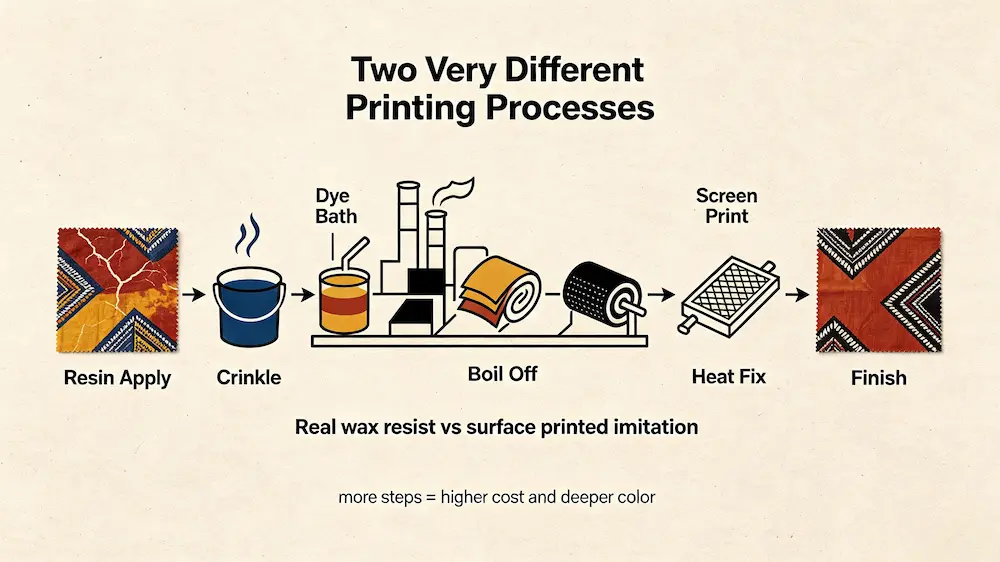
Real wax print follows a manufacturing technique that Dutch textile mills originally developed in the 19th century, inspired by Indonesian batik. The key principle is wax-resist dyeing: manufacturers apply melted resin (traditionally wax, now often a synthetic resin blend) to both sides of the fabric before submerging it in dye. The resin blocks dye absorption on the covered areas, creating the pattern. For multi-color designs, workers repeat this process — apply resin, dye, remove resin — for each color in the design.
According to the history of African wax prints, Dutch manufacturers like Vlisco pioneered this method using modified Perrotine block-printing machines and later roller-printing technology. The resin application happens on both sides of the cloth, producing a fabric where the pattern penetrates through to the reverse side with nearly equal intensity.
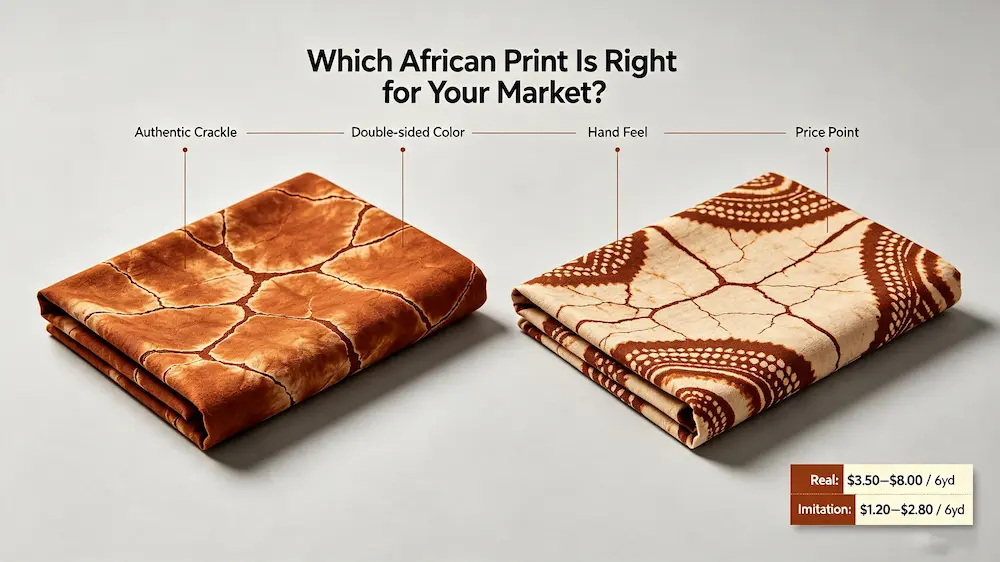
The defining feature of real wax print is the crackle effect: manufacturers intentionally crinkle the resin layer before dyeing, creating fine, irregular lines across the pattern. These crackles — also called “ice lines” or “crazing” — form the signature aesthetic that consumers across West and Central Africa associate with authentic, high-quality wax print.
What Is Imitation Wax Print?
Imitation wax print — also known in the trade as “fancy print,” “Java print,” or “roller print” — uses conventional textile printing methods. Instead of wax-resist dyeing, manufacturers print the design directly onto the fabric surface using rotary screen printing, flat screen printing, or digital printing.
At our production facility, the rotary screen and flat screen printing lines apply color to one side of the fabric. The design does not penetrate through to the reverse side; instead, the back of the cloth shows a paler, less saturated version of the pattern — or, in some cases, no pattern at all. This single-sided characteristic is the fastest visual identifier in the real wax print vs imitation wax print distinction.
Manufacturers can produce imitation wax prints on a much wider range of base fabrics — 100% cotton, 100% polyester, or cotton-polyester blends — using either reactive dye printing or pigment printing. The production process runs significantly faster and requires far fewer steps than real wax printing.
Process Comparison: Step by Step
Visual and Physical Differences
When you hold a real wax print and an imitation wax print side by side, four differences stand out:
1. Double-sided color. Real wax print shows vibrant, evenly saturated color on both sides of the fabric. Imitation wax print shows strong color only on the printed face; the reverse side is pale or blank. For garments, particularly wraps and dresses where both sides may be visible, this difference matters.
2. Crackle effect authenticity. Real wax crackles appear as fine, random, organic lines — a byproduct of the resin-crinkling process. Imitation wax crackles, when present, look more uniform and mechanical because a screen printed them onto the surface. Experienced buyers can spot the difference immediately.
3. Hand feel. Real wax print typically carries a slightly waxy, crisp hand feel — a legacy of the resin process. Many West African consumers associate this feel with quality and authenticity. Imitation wax print offers a softer, more fabric-like drape, which some markets prefer for everyday wear.
4. Color depth and richness. Because real wax dye penetrates the fiber through immersion dyeing, the colors achieve a depth that surface printing cannot fully replicate. Our premium African wax print fabrics demonstrate this depth, particularly in deep indigo, rich burgundy, and vibrant yellow tones that remain striking even after repeated washing.
Pricing Logic: Why the Cost Gap Exists
The real wax print vs imitation wax print pricing gap reflects fundamental differences in production economics:
- Real wax print: USD 3.50–8.00 per 6-yard piece (FOB China)
- Imitation wax print: USD 1.20–2.80 per 6-yard piece (FOB China)
Three factors drive the price difference:
Labor intensity. Real wax printing demands multiple manual or semi-automated steps: resin preparation, application, crinkling, dyeing, boiling, and drying — repeated for each color. A 3-color real wax design requires three complete cycles. Imitation wax prints run through a rotary screen line once, regardless of color count.
Material costs. Real wax consumes resin, dye bath chemicals, and significant water per meter. Imitation wax uses standard textile inks and lower water volumes.
Production speed. A rotary screen line at Tianhong Textile can output 90 million meters per year across 9 lines. Real wax production, by contrast, runs far slower — the process simply cannot match the throughput of modern screen printing. Lower output per machine-hour means higher fixed cost per meter.
However, the price difference does not simply reflect a “better vs. worse” judgment. Each product type serves a distinct market segment, and the right choice depends on your customer base.
Which Product Fits Your Market?
Choose real wax print when:
- Your customers serve the premium segment in West and Central African markets (Nigeria, Ghana, Côte d’Ivoire, Senegal).
- Your buyers expect the crackle effect and double-sided color as non-negotiable quality markers.
- You sell occasion wear — weddings, naming ceremonies, church events — where consumers willingly pay more for authenticity.
- You compete against European imports (Vlisco, Uniwax) and need a comparable-quality product at a more accessible price point.
Choose imitation wax print when:
- Your customers serve the mass market or value-conscious consumer segment.
- You need high-volume, fast-turnaround production.
- Your buyers prioritize pattern variety and trend responsiveness over traditional production methods.
- You supply markets in East Africa, Southern Africa, or non-African regions where the crackle effect carries less cultural weight.
A growing number of importers stock both product types — real wax for their premium catalog and imitation wax for volume. This dual strategy lets you cover the full market without sacrificing margin on either end. Explore our full range of African wax fabrics and customizable wax prints to see how both categories can work for your business.
Quality Control Considerations
Regardless of which type you choose, specify these quality parameters in your purchase contract:
- Color fastness to washing: Grade 4 minimum (ISO 105-C06) — essential for wax prints that consumers will hand-wash repeatedly.
- Color fastness to rubbing: Grade 3–4 minimum for dry, Grade 3 for wet (ISO 105-X12) — prevents dye transfer in humid climates.
- Shrinkage: ≤3% in both warp and weft after three washes.
- Fabric width tolerance: ±2 cm from specified cuttable width.
At Tianhong Textile, our in-house physical testing laboratory performs these tests on every production batch, and we provide third-party SGS or Bureau Veritas inspection reports on request.
Frequently Asked Questions
Q: Does real wax print always use 100% cotton?
A: Traditional real wax print uses 100% cotton because the immersion dyeing process requires cellulose fibers for proper dye uptake. However, manufacturers can produce imitation wax prints on 100% cotton, 100% polyester, or cotton-polyester blends. At Tianhong Textile, we offer cotton and polyester options across our entire wax print range.
Q: How can I tell real wax from imitation wax on a sample swatch?
A: Check three things: (1) Flip the swatch — if the reverse side looks nearly as vibrant as the front, you likely have real wax. A pale or blank reverse indicates imitation. (2) Look for organic, irregular crackle lines — printed crackles look too uniform. (3) Feel the fabric — real wax has a slightly crisp, waxy hand; imitation wax drapes softer.
Q: Why does real wax print cost 2–3 times more than imitation wax?
A: The cost gap comes from production complexity. Real wax requires a separate wax-dye-boil cycle for each color in the design, consuming more labor, time, water, and materials. Imitation wax prints in a single screen-printing pass. Slower output per machine-hour directly translates to higher cost per meter.
Q: Can I order custom designs in real wax print?
A: Yes, but the MOQ will be higher than for imitation wax. The screen engraving and resin-roller setup costs for real wax mean that custom designs become economical at 10,000–20,000 meters. For smaller trial orders, consider starting with custom imitation wax prints — which carry lower setup costs — and scaling to real wax once your design proves itself in the market.
Q: Which African countries prefer real wax, and which prefer imitation?
A: Generally, West and Central African markets — Nigeria, Ghana, Côte d’Ivoire, Senegal, Togo, Benin — show the strongest preference for real wax print and its crackle effect. East and Southern African markets — Kenya, Tanzania, South Africa — often favor imitation wax for its lower price, softer feel, and faster-changing design cycles. That said, market segments exist within every country, and our export team can advise on regional preferences based on your target customers.
Q: Is imitation wax print lower quality?
A: Not necessarily. A well-produced imitation wax print with proper color fastness (Grade 4+), consistent pattern registration, and good hand feel is a high-quality product — it simply uses a different manufacturing process. The question is not “which is better” but “which matches your market’s expectations and price point.”