

Walk through any bedding aisle in Dubai, Lagos, or Jakarta, and the packaging screams a single number: “1000 Thread Count!” The marketing logic seems simple — bigger numbers mean better quality. However, for the polyester and microfiber bedding that dominates wholesale markets across Africa, the Middle East, and Southeast Asia, that number is almost entirely meaningless. Worse, it often masks the one metric that actually determines how the sheets feel, how long they last, and whether your customer comes back for a second purchase.
That metric is GSM — grams per square meter — the true measure of fabric weight and thread count quality. At Weifang Tianhong Textile Co., Ltd., we manufacture over 90 million meters of home textile fabric annually. This article demystifies the numbers on the label so you can buy what your market actually wants — not what the marketing department invented.
1. The Thread Count Myth: Why That 1000 Number Is Fiction
1.1 What Thread Count Actually Means — and What It Doesn’t
Thread count measures the number of threads woven into one square inch of fabric — counting both the vertical (warp) and horizontal (weft) threads. A genuine 200-thread-count cotton sheet contains roughly 100 warp threads and 100 weft threads per square inch.
However, this measurement has a hard physical limit. You can physically fit only so many cotton threads into a square inch before the fabric becomes stiff, heavy, and unbreathable. For single-ply cotton, that limit sits around 400–500. Any number above that — 800, 1000, 1200 — is almost certainly a manufacturing trick: twisting multiple thin yarns together (multi-ply construction) and counting each ply as a separate thread. A “1000 thread count” sheet made from 4-ply yarn actually contains only 250 threads per square inch — but the marketing department counted each ply as a thread (Consumer Reports).
1.2 Why Thread Count Is Irrelevant for Polyester and Microfiber
For polyester and microfiber bedding — the products that dominate wholesale markets and that Tianhong Textile produces at industrial scale — thread count is completely irrelevant. Microfiber threads are extruded as continuous filaments, not spun from short cotton staples. A single polyester filament can measure less than 1 denier — far finer than the finest cotton yarn. Consequently, manufacturers can cram thousands of these ultra-fine filaments into a square inch, producing meaningless thread count numbers that bear no relationship to the fabric’s actual quality, durability, or comfort.
A “1500 thread count” microfiber sheet set sounds impressive on the packaging. In reality, the number tells you nothing about how the fabric will feel, wear, or wash. For polyester bedding buyers, the only metric that matters is GSM.
2. GSM: The Real Metric of Bedding Quality
2.1 What GSM Measures
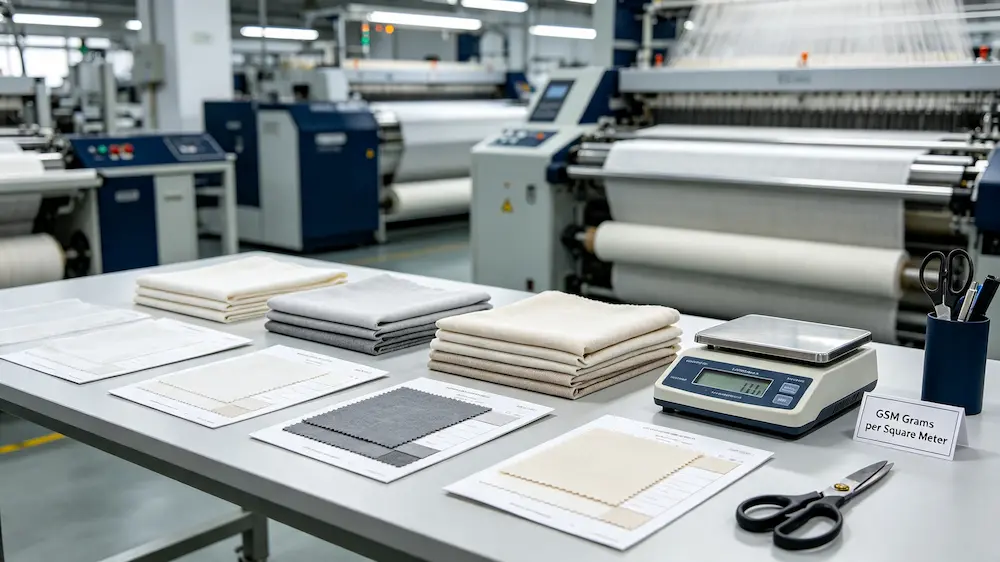
GSM — grams per square meter — measures the physical weight and density of the fabric. A fabric sample measuring exactly one meter by one meter is weighed. The result, expressed in grams, is the GSM. Unlike thread count, which manufacturers can manipulate through ply-count tricks, GSM is a direct physical measurement. You cannot fake it. You cannot inflate it. A 120 GSM fabric weighs 120 grams per square meter — period.
When you evaluate fabric weight and thread count together, GSM reveals what the thread count hides. A “600 thread count” sheet with 70 GSM will feel thin, flimsy, and will develop holes within 10–15 washes. A “200 thread count” sheet with 130 GSM will feel substantial, drape well, and survive 50+ industrial wash cycles. The GSM told you the truth; the thread count told you a story.
2.2 GSM Ranges and What They Mean for Polyester Bedding
At Tianhong Textile, we produce polyester bedding fabric from 90 GSM to 180+ GSM, with custom GSM specifications available for orders meeting minimum quantity requirements. Our integrated production chain — from yarn texturing through weaving, dyeing, printing, and finishing — ensures consistent GSM across every meter of fabric in your order.
3. Why GSM Matters More Than Thread Count for Wholesale Buyers
3.1 GSM Predicts Customer Satisfaction — Thread Count Predicts Nothing
When your customer opens a bedding set at home, they form an opinion in seconds. They touch the fabric. The fabric either feels “quality” or “cheap.” That tactile judgment — the hand feel, the weight, the drape — correlates almost perfectly with GSM. It correlates with thread count not at all.
A customer who buys a 70 GSM “1000 thread count” sheet set will feel cheated the moment they touch it. They may not know what GSM means, but their fingers will tell them the fabric is thin and flimsy. They will not buy from you again. A customer who buys a 130 GSM “200 thread count” sheet set will feel the weight, the softness, and the quality. They will come back.
3.2 GSM Determines Durability — and Durability Drives Repeat Orders
For institutional buyers — hotels, hospitals, dormitories — durability is everything. A hotel changing sheets 300 times per year per room cannot afford bedding that tears after 20 washes. The relationship between fabric weight and thread count durability is straightforward: higher GSM fabric withstands more wash cycles, resists pilling better, and maintains its appearance longer.
For the wholesale bedding importer, this durability translates into a critical business metric: repeat order rate. A hotel that tries your 90 GSM sheets and replaces them after 3 months will look for another supplier. A hotel that tries your 140 GSM sheets and replaces them after 18 months will reorder from you — and tell other hotel managers about you.
4. How to Specify GSM When Ordering from Tianhong Textile
4.1 The Specification Process
When you contact Tianhong Textile for a bedding quotation, specify your GSM requirement upfront. The GSM determines:
- The base fabric construction: Yarn denier, weave density, and finishing process all change depending on the target GSM.
- The price per meter (or per set): Higher GSM fabrics use more raw material and cost proportionally more. A 140 GSM fabric will cost roughly 25–40% more than a 110 GSM fabric of the same width and construction.
- The shipping volume: Higher GSM fabric is thicker — fewer meters fit in a container. A 40-foot container holds approximately 15% fewer 140 GSM sheet sets than 110 GSM sets.
4.2 Our Quality Guarantee
Every batch of Tianhong Textile bedding fabric undergoes laboratory GSM testing — a physical measurement, not an estimate. If your specification requires 130 GSM with a tolerance of ±5%, we deliver fabric within that range. This consistency ensures that the 100th roll in your shipment feels identical to the 1st roll — a critical requirement for brand-building in competitive bedding markets.
For orders requiring custom GSM, print design, or packaging, our MOQ typically starts at 3,000–5,000 sets per design. Contact our trade team with your target market, preferred GSM range, and design requirements for a tailored quotation.
5. Frequently Asked Questions (FAQ)
Q: What GSM should I choose for my target market?
A:This depends on your market positioning:
-
Budget retail & open-market sales (price-sensitive regions): 90–110 GSM offers an acceptable product at a competitive price.
-
Mid-market retail & hospitality supply: 120–140 GSM delivers the quality that drives repeat orders.
-
Premium retail, bridal, and luxury hotel segments: 150–180 GSM provides the heavy, luxurious hand feel that justifies premium pricing.
If you’re uncertain, we recommend ordering sample swatches at 110, 130, and 150 GSM. A physical comparison will clarify your market’s preference far more quickly than any specification sheet.
Q: Does Tianhong Textile use reactive or pigment printing on bedding fabric?
A: We operate both reactive dye printing lines (2 lines, 20 million meters/year for premium cotton and premium polyester applications) and pigment printing lines (9 lines, 90 million meters/year for volume-driven polyester production). For polyester bedding, pigment printing is the standard — it provides vibrant colors with good wash fastness at a competitive cost. For premium bedding lines where maximum color fastness and the softest possible hand feel are required, reactive printing is available on cotton and selected polyester grades. Our trade team can advise on the appropriate printing technology for your target market and price point.
Q: How does GSM affect the shipping cost of my bedding order?
A: Higher GSM fabric occupies more volume per unit of weight because it is thicker. A 40-foot container holds approximately 15–25% fewer 140–150 GSM sheet sets than 90–110 GSM sets, depending on packaging compression. This means your per-unit shipping cost is higher for heavier fabric. However, the higher selling price that heavier fabric commands typically more than offsets the shipping cost difference. We recommend calculating the landed cost per set (FOB price + freight allocation) for multiple GSM options to identify the most profitable configuration for your market.
Q: Can Tianhong Textile provide both the fabric weight we need and a competitive wholesale price?
A: Yes. Because Tianhong Textile operates an integrated production chain — in-house texturing, weaving (600 water-jet + 150 air-jet looms), dyeing, printing, and finishing — we control the cost at every production stage. Unlike converters who purchase base fabric from a third-party mill and then print it, we produce the fabric ourselves. This vertical integration eliminates the margin stacking that inflates FOB prices when each process is subcontracted. For buyers placing orders of 10,000+ sets, this structural cost advantage translates to competitive pricing without compromising on GSM or print quality.
6. Conclusion
The bedding industry has spent decades training consumers to worship thread count — a number that is meaningless for polyester and microfiber fabrics, easily manipulated by manufacturers, and no predictor of quality, durability, or comfort. The wholesale buyer who understands this has a competitive advantage over every competitor who still buys based on thread count.
GSM — grams per square meter — is the real quality metric. It measures what the consumer’s fingers feel. It predicts how many wash cycles the fabric will survive. And it determines whether your customer reorders from you or from your competitor. When you evaluate fabric weight and thread count side by side, GSM always tells the truth.
Weifang Tianhong Textile Co., Ltd. brings a 162,373-square-meter integrated production base, 75+ production units, 110+ million meters of annual output, and over 20 years of textile manufacturing expertise to your bedding order. Our polyester bedding sets — available in 4-piece and 7-piece configurations, from 90 to 180+ GSM, with custom print design and packaging — serve wholesale markets across Africa, the Middle East, and Southeast Asia.
Contact our trade team to request fabric swatches, discuss GSM specifications, or receive a customized quotation for your market.