

The Gulf abaya market operates on its own rhythm. While global fashion cycles shift every season, the Gulf’s modest fashion sector moves to a different beat — one shaped by cultural expectations, climate demands, and a rapidly evolving consumer who expects both tradition and innovation in a single garment.
For fabric buyers and wholesalers, tracking these trends is not a luxury. It is the difference between stocking fabric that moves within weeks and watching inventory gather dust while your competitors capture the season’s demand. The 2026–2027 cycle brings significant shifts in fabric weight preferences, texture innovations, color palettes, and regional differentiation that wholesale buyers cannot afford to ignore.
This guide breaks down what fabric buyers serving the GCC should know right now — from the specifications driving purchase decisions to the regional preferences that vary between Dubai, Riyadh, Kuwait City, and Doha.
The Gulf Abaya Market at a Glance
Before diving into fabric specifics, understanding the market structure helps frame smart sourcing decisions.
The Gulf Cooperation Council (GCC) abaya market continues to grow, driven by population expansion, rising disposable income, and a cultural shift toward abayas as fashion statements rather than purely functional garments. Saudi Arabia alone represents the largest abaya market in the region, with women typically owning multiple abayas for different occasions — daily wear, formal events, Ramadan, and Eid celebrations. The UAE market skews more fashion-forward, with faster trend cycles and greater openness to experimental fabrics and silhouettes. Kuwait and Qatar sit between these poles: conservative in cut but increasingly demanding in fabric quality.
Fabric Weight: The Lightweight Revolution Continues
Fabric weight — measured in grams per square meter (GSM) — remains the single most important specification for abaya fabric in Gulf markets. And the trend continues its march toward lighter constructions.
The GSM Sweet Spot for 2026–2027
Three years ago, abaya fabrics in the 120–150 GSM range dominated daily wear categories. Today, buyers increasingly demand fabrics in the 90–120 GSM range for everyday abayas, with premium lines pushing into the 75–90 GSM category for summer and Ramadan collections.
The drivers are straightforward. Gulf summers continue to test the limits of wearability, with temperatures routinely exceeding 45°C in Dubai, Riyadh, and Doha. A 25–30% reduction in fabric weight translates directly into a cooler, more comfortable wearing experience — and consumers have learned to feel the difference. Additionally, the popularity of layered abaya styles (abaya worn over a dress or wide-leg trousers) means the outer layer must remain lightweight enough to avoid a heavy, bulky silhouette.
However, lighter weight introduces a quality challenge: ultra-light fabrics can become sheer under bright Gulf sunlight. The solution that manufacturers have refined is ultra-fine denier microfiber — 100% polyester fabric that achieves exceptional lightness while maintaining full opacity through tightly packed, extremely fine yarns rather than heavy coatings or thick weaves.
At Weifang Tianhong Textile, our ultra-fine denier microfiber abaya fabric hits the 80–100 GSM range with full opacity, delivering the lightweight breathability Gulf consumers demand without the sheerness that triggers returns.
Seasonal Weight Strategies
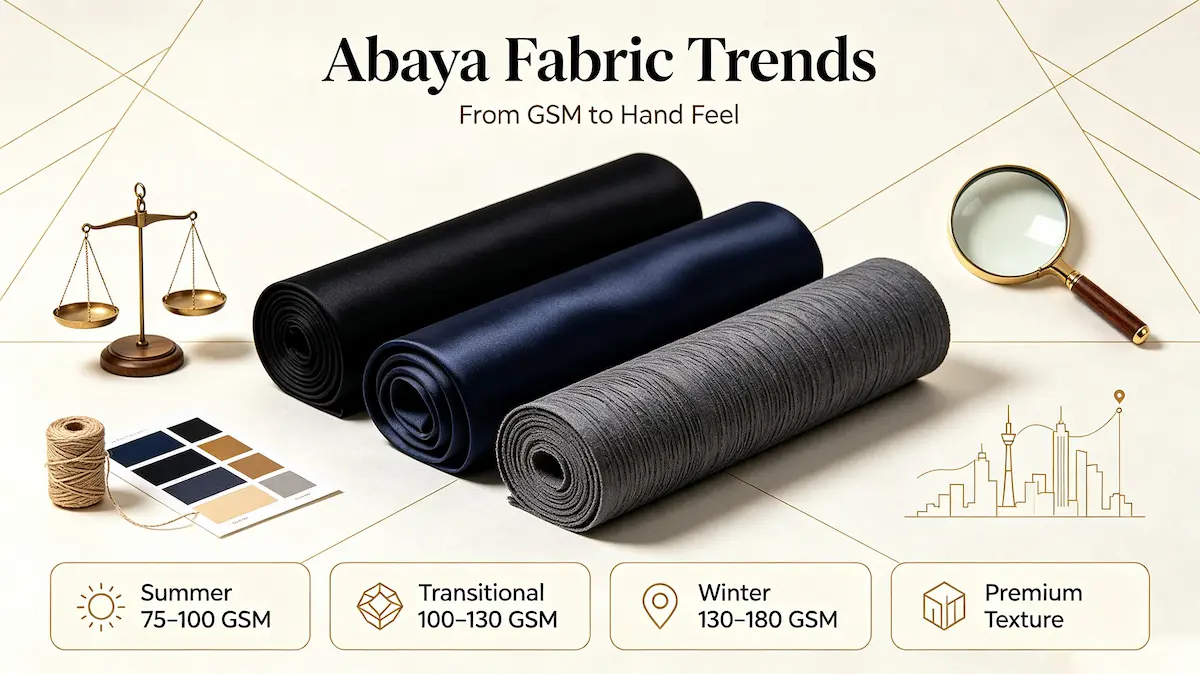
Smart wholesale buyers now plan abaya fabric inventory across three weight tiers:
The summer tier represents the highest volume. The winter tier commands the highest per-meter price. Successful wholesalers stock all three.
For more technical detail on microfiber properties, read our guide on ultra-fine denier microfiber for abaya.
Texture and Finish: The New Battleground
If fabric weight determines comfort, texture and finish determine perceived value. And in 2026–2027, texture has become the primary differentiator between premium and budget abaya fabric.
The Rise of Textured Surfaces
Flat, smooth abaya fabric dominated the market through 2023. Today, three texture categories command premium pricing:
Subtle crepe textures produce a fine, even pebble effect that adds visual depth without bulk. Crepe-textured abaya fabric drapes beautifully, resists wrinkles, and photographs well — a critical factor in the Instagram-driven Gulf fashion market where abaya boutiques market heavily through social media imagery.
Micro-embossed patterns apply heat-pressed surface designs — geometric motifs, floral repeats, or abstract textures — that catch light at different angles. These fabrics create a sense of embellishment without requiring embroidery or appliqué, keeping the garment lightweight and machine-washable. Saudi buyers particularly favor micro-embossed abayas for formal occasions where traditional embellishment would add unwanted weight and cost.
Matte-satin finishes bridge the gap between day and evening wear. A matte face with a subtle sheen creates a fabric that transitions from office to dinner without looking out of place in either setting. This category has grown 30–40% year over year across UAE and Kuwait wholesale channels.
The Hand Feel Imperative
Gulf consumers touch fabric before they buy. Period. No online product description, no matter how detailed, replaces the physical experience of running fingers across a bolt of abaya fabric. This behavioral reality means hand feel is not a secondary attribute — it is a primary purchase trigger.
For 2026–2027, the preferred hand feel across Gulf markets splits into two camps:
- Soft, fluid, barely-there — dominates the daily wear and summer categories. The fabric almost disappears against the skin, draping like a second layer of air. Ultra-fine denier microfiber from manufacturers like Tianhong Textile achieves this hand feel through extremely fine yarn construction rather than chemical softening agents that wash out.
- Crisp, structured, luxurious — preferred for formal and winter abayas. The fabric holds shape, resists creasing, and communicates quality through its weight and body. This hand feel typically requires slightly heavier GSM and specialized finishing equipment — calenders and stenters — which our integrated manufacturing facility applies in-house.
Color Direction: Beyond Black — But Not Too Far
Black remains the dominant abaya color across every GCC market by an overwhelming margin. Estimates place black abayas at 70–80% of total volume. However, the 2026–2027 cycle shows a meaningful expansion of the non-black segment.
The Neutral Expansion
Dark neutrals — charcoal, deep navy, espresso brown, and midnight blue — represent the fastest-growing color category. These shades satisfy cultural expectations for modesty and understatement while offering consumers a point of differentiation from the sea of black abayas at social gatherings. Retail buyers report that dark-neutral abayas now account for 15–20% of sales volume in premium boutiques, up from under 10% three years ago.
Seasonal Color Injections
During Ramadan and Eid, pastel and jewel-tone abayas see a sharp but temporary demand spike. Dusty pink, sage green, lavender, and soft beige move quickly in the four weeks before Eid, then return to baseline. Wholesale buyers who stock these seasonal colors must calibrate order quantities carefully — over-ordering leaves dead inventory for 10 months until the next Ramadan cycle.
Regional Color Preferences
- Saudi Arabia: Most conservative on color. Black dominates beyond 85%. Dark neutrals grow slowly. Seasonal colors perform only during Ramadan and Eid.
- UAE: Most adventurous on color. Neutral abayas and soft pastels sell year-round, particularly in Dubai’s fashion-forward boutiques. Abaya-as-fashion-statement culture drives faster color experimentation.
- Kuwait: Balances Saudi conservatism with UAE fashion interest. Dark neutrals perform well. Bright or light colors remain limited to specific seasonal windows.
- Qatar: Similar to Kuwait in color preference, with slightly higher openness to earth tones and warm neutrals.
Regional Market Differences: One Gulf, Four Markets
While international buyers sometimes treat the GCC as a single market, fabric preferences vary meaningfully by country.
Saudi Arabia: Volume and Tradition
Saudi Arabia consumes more abaya fabric than the rest of the GCC combined. The market splits into two distinct segments: mass-market daily wear (price-sensitive, basic specifications, very high volume) and premium formal wear (quality-driven, texture-embellished, higher per-meter price).
For mass-market Saudi buyers, fabric must deliver three non-negotiables: full opacity, wrinkle resistance, and a price point that supports competitive retail at 150–250 SAR per abaya. Ultra-fine denier microfiber in the 90–110 GSM range hits all three.
For premium Saudi buyers, specifications tighten: GSM may drop to 80–90 for lightness, but texture, drape, and surface finish must communicate luxury. Micro-embossed and crepe textures find their strongest Saudi market in this premium segment.
UAE: Fashion Speed and Fabric Innovation
The UAE market cycles faster than any other GCC country. A fabric trend that starts in Dubai in January reaches Riyadh in June and Kuwait in September. For wholesale buyers, this means UAE orders require shorter lead times, smaller minimum quantities per design, and readiness to discontinue underperformers quickly.
Fabric innovation acceptance runs highest in the UAE. Cool-touch finishes — fabric treatments that create a perceptible cooling sensation on skin contact — first gained traction in Dubai and Abu Dhabi before spreading regionally. Antimicrobial and moisture-wicking finishes also see earlier UAE adoption.
Kuwait and Qatar: Quality Over Quantity
Kuwaiti and Qatari buyers purchase fewer abayas per capita than Saudi buyers but spend significantly more per garment. This market skews toward premium fabric specifications: lighter weights, finer textures, and more elaborate surface finishes. The overall volume is smaller, but the per-meter margin potential is higher, making these markets attractive for wholesalers who can meet the elevated quality bar.
The Supply Chain Advantage: Why Chinese Microfiber Leads
Gulf abaya fabric sourcing has shifted meaningfully over the past five years. Traditional sourcing from regional textile hubs (Dubai-based traders, Turkish converters) increasingly gives way to direct sourcing from Chinese manufacturers — driven by both price and technical capability.
China’s advanced water-jet loom infrastructure produces ultra-fine denier polyester at scales and consistency levels that regional converters struggle to match. A single integrated Chinese mill like Tianhong Textile can run 600 water-jet looms simultaneously, producing uniform fabric across production batches that span thousands of meters. This consistency eliminates the batch-to-batch variation that frustrates abaya designers who need reliable color matching across production runs.
Furthermore, full-chain integration — where texturing, weaving, dyeing, finishing, and quality testing happen under one roof — eliminates the handoff delays and quality gaps that plague fragmented supply chains. For Gulf buyers who need fabric delivered before Ramadan or Eid, every week of predictable lead time matters.
Our 162,373-square-meter production campus in Weifang, Shandong, produces ultra-fine denier abaya fabric with full traceability from yarn to finished bolt. Gulf wholesale buyers receive consistent specifications — GSM, width, color, hand feel — across every shipment, supported by in-house laboratory testing that verifies each production batch.
For additional context on quality evaluation, read our guides on advanced textile manufacturing and common import pitfalls.
Frequently Asked Questions
Q: What GSM range do Gulf consumers prefer for daily-wear abayas in 2026–2027?
The preferred range has shifted to 90–120 GSM for daily wear, with premium lines pushing into 75–90 GSM for summer and Ramadan collections. Five years ago, 120–150 GSM dominated. The trend toward lighter weights continues as consumers prioritize comfort in extreme heat and adopt layered abaya styles that demand a lightweight outer layer.
Q: Do black abayas still dominate, or are colors gaining ground?
Black still dominates at 70–80% of total volume across GCC markets. However, dark neutrals (charcoal, navy, espresso, midnight blue) now represent 15–20% of premium boutique sales — up from under 10% three years ago. Pastel and jewel-tone abayas spike during Ramadan and Eid season but return to low baseline volumes for the rest of the year.
Q: What fabric finishes are trending in Gulf abaya markets?
Three texture categories command premium attention: subtle crepe textures (fine pebble effect, excellent drape), micro-embossed patterns (heat-pressed surface designs that catch light), and matte-satin finishes (matte face with subtle sheen for day-to-evening versatility). Cool-touch finishes also gain traction, particularly in the UAE market. Flat, smooth abaya fabric continues to sell at the budget end but increasingly loses premium share to textured alternatives.
Q: How do abaya fabric preferences differ between Saudi Arabia and the UAE?
Saudi Arabia represents the largest volume market and splits between mass-market daily wear (price-sensitive, 90–110 GSM, basic specifications) and premium formal wear (textured, lighter weight, higher price). The UAE cycles trends faster, accepts fabric innovation more readily (cool-touch, antimicrobial finishes), and shows greater openness to non-black colors in daily wear. A fabric trend that starts in Dubai typically reaches Riyadh six months later and Kuwait nine months later.
Q: Why source abaya fabric directly from China rather than from regional distributors?
Direct Chinese sourcing offers three advantages: better pricing through elimination of intermediary margins, more consistent batch-to-batch quality from integrated mills running hundreds of looms simultaneously, and the ability to customize specifications (GSM, width, color, finish) rather than choosing from whatever regional distributors have in stock. The lead time trade-off — typically 25–35 days sea freight to Gulf ports — requires planning but delivers per-meter savings that compound significantly at wholesale volumes.
Q: What certifications should I request when sourcing abaya fabric?
Request OEKO-TEX Standard 100 certification to verify that the fabric contains no harmful substances — increasingly important for Gulf retailers who market abaya safety and skin-friendliness. Also request lab test reports for color fastness to washing and rubbing (ISO 105-C06 and ISO 105-X12) and fabric weight verification (GSM). Tianhong Textile provides these certifications and test reports with every production batch.
Q: Can Tianhong Textile customize abaya fabric specifications for my market?
Yes. We offer full customization of GSM (typically 75–180 range), fabric width, color matching to your specifications, surface texture (crepe, embossed, matte-satin), and functional finishes. Our integrated manufacturing setup allows us to develop custom specifications and maintain them consistently across repeat orders. Contact our trade team to discuss your requirements and receive fabric swatches for evaluation.
Conclusion
The Gulf abaya fabric market in 2026–2027 rewards buyers who track three shifts: the continued migration toward lighter weights, the elevation of texture from afterthought to primary differentiator, and the growing — if measured — expansion beyond traditional black.
Success in this market depends less on guessing which single trend will dominate and more on building a fabric portfolio that covers the weight spectrum (summer light through winter formal), the texture spectrum (flat through embossed), and the color spectrum (black through seasonal neutrals). Gulf consumers may disagree on individual preferences, but they agree on one thing: abaya fabric must feel exceptional against the skin, drape beautifully, and survive the region’s climate without compromising modesty or comfort.
Weifang Tianhong Textile supplies ultra-fine denier microfiber abaya fabric to Gulf wholesale buyers from our fully integrated 162,373-square-meter manufacturing campus. With production capacity spanning 20 million meters of reactive-dyed fabric and 90 million meters of pigment-printed fabric annually, we match volume capability with the customization flexibility that Gulf markets demand.
Contact our trade team for fabric swatches, GSM samples, and a customized wholesale quotation.