

If you import and distribute African wax print fabrics, timing is everything. Order too late, and you miss the peak selling window — leaving your stockroom full of unsold inventory. Order too early, and your working capital gets tied up for months. Understanding African wax print seasonal demand is the single most powerful lever for protecting your margins.
At Tianhong Textile, we have spent over 20 years supplying premium African wax print fabrics to wholesalers and distributors across Africa, Southeast Asia, and the Middle East. In this guide, we break down the year-round demand calendar, highlight the best time to import Ankara fabric for each key season, and share a practical framework for wax print inventory planning that keeps your cash flow healthy and your customers satisfied.
Why Seasonal Timing Drives Your Profit Margin
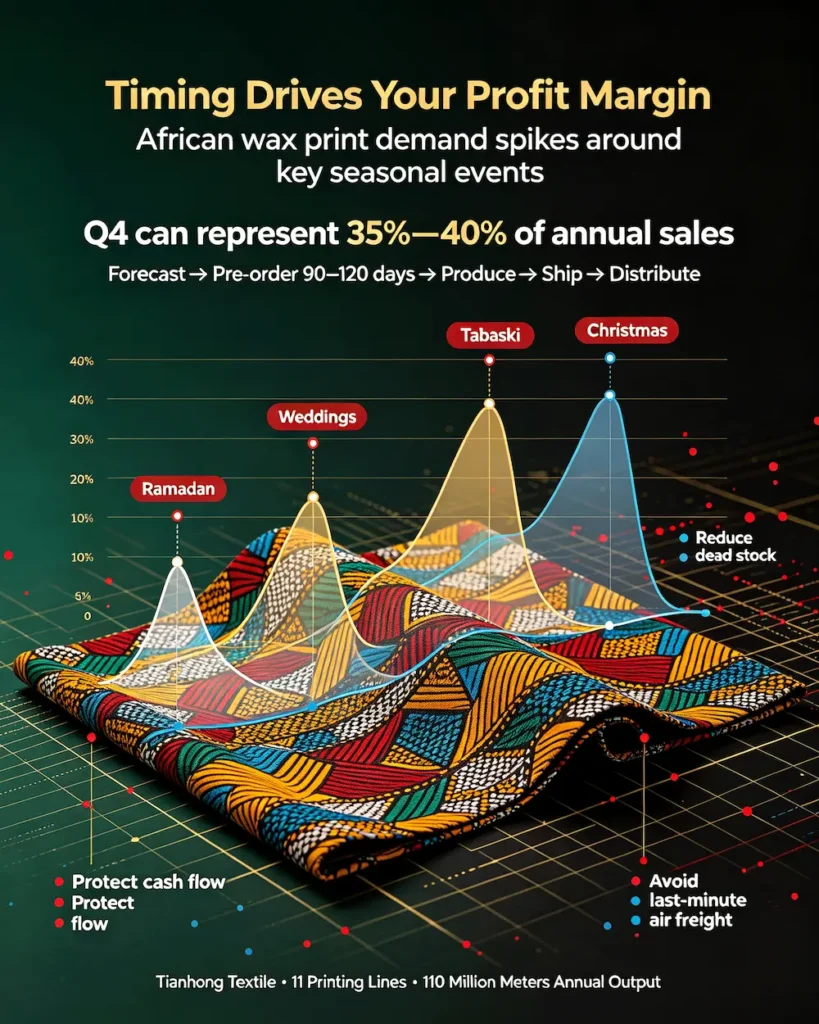
Wax print demand is not flat — it spikes sharply around cultural, religious, and social events. When you align your procurement with these cycles, three things happen:
- You command higher wholesale prices because demand outstrips supply during peak windows.
- You reduce dead stock by ordering the right quantities for each season rather than guessing.
- You strengthen supplier relationships through predictable, well-timed purchase orders.
Conversely, poor timing means you either sell at a discount after the peak passes or lose sales entirely to better-prepared competitors. This is why African wax print seasonal demand forecasting should sit at the center of your sourcing strategy.
The Annual Wax Print Demand Calendar
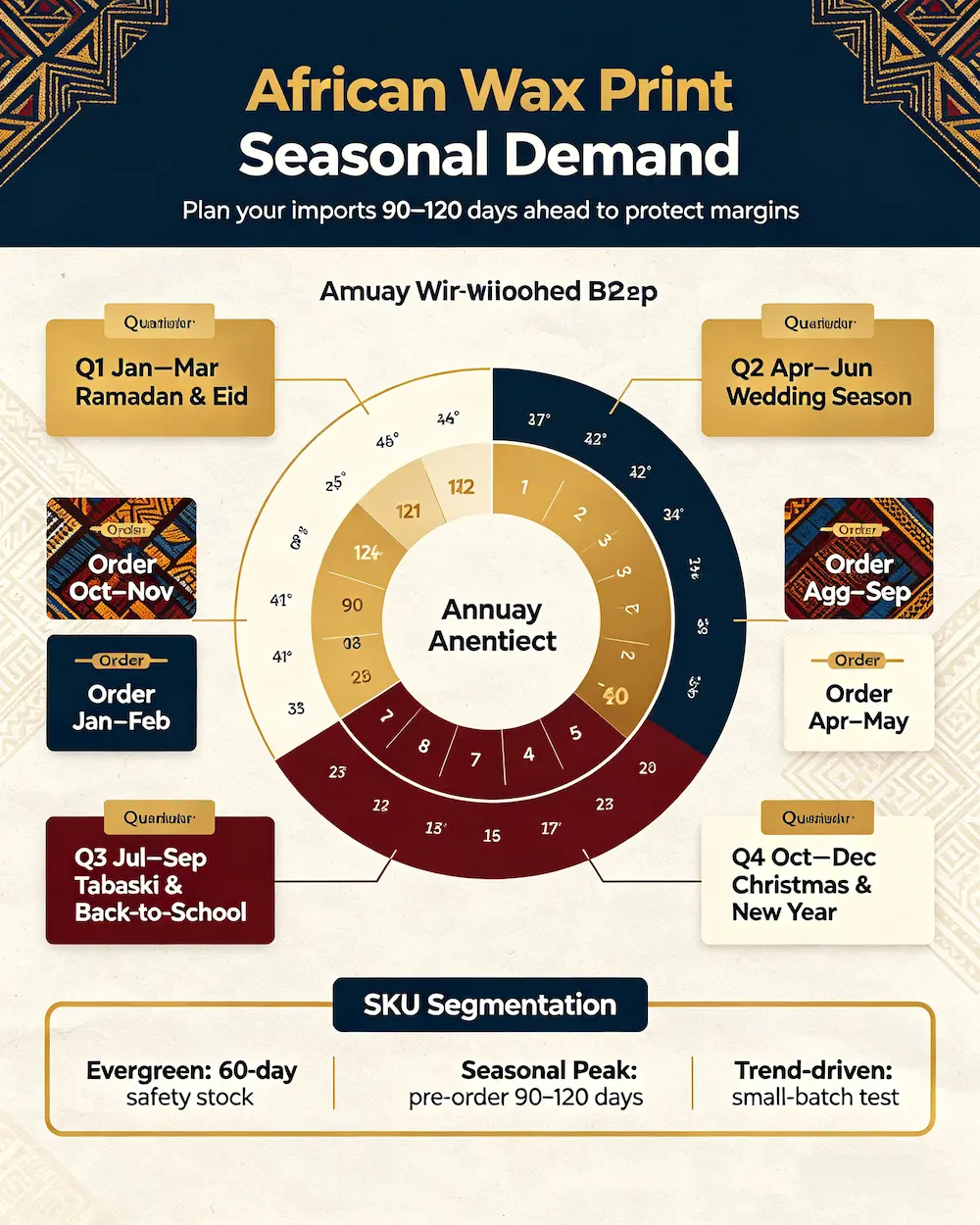
Below is a month-by-month breakdown of the major demand drivers. Use this as your reference for wax print inventory planning throughout the year.
Q1 (January – March): Ramadan and Eid Preparations
Demand driver: Ramadan and Eid al-Fitr are among the most significant consumption events for wax print fabrics in Muslim-majority markets including Nigeria, Senegal, Mali, and Guinea.
- Peak retail window: 4–6 weeks before Ramadan (which shifts ~10 days earlier each year in the Gregorian calendar).
- Recommended ordering window: October – November of the preceding year. This is the best time to import Ankara fabric for Ramadan demand — sea freight takes 30–45 days, and you need buffer time for customs clearance and inland distribution.
- Fabric preferences: Rich jewel tones, intricate geometric patterns, and heavier cotton weights for traditional boubou and kaftan styles.
Key insight: Because Ramadan dates move annually, verify the Islamic calendar at least 6 months ahead. A common mistake is using last year’s dates and missing the window by two weeks — which can cost you 30% or more in lost margin.
Q2 (April – June): Wedding Season and Graduation
Demand driver: In many West and Central African markets, April through June marks the peak wedding season. Families purchase wax print in bulk for bridal parties, guest attire, and ceremonial gifting.
- Peak retail window: Late March – May.
- Recommended ordering window: January – February.
- Fabric preferences: Bold, celebratory patterns in gold, red, and royal blue; high-end “super wax” and “java print” qualities.
Wedding-related demand tends to favor premium grades. If your product line includes both entry-level and premium African wax print options, Q2 is when your higher-margin SKUs should be fully stocked.
Q3 (July – September): Back-to-School and Tabaski (Eid al-Adha)
Demand driver: Tabaski (Eid al-Adha) rivals Ramadan in textile consumption across Senegal, Mali, Guinea, and Côte d’Ivoire. Combined with back-to-school uniform demand in some markets, Q3 can be surprisingly strong.
- Peak retail window: 2–4 weeks before Tabaski (dates shift annually; check the Islamic lunar calendar).
- Recommended ordering window: April – May.
- Fabric preferences: Similar to Ramadan — vibrant, high-contrast designs. Additionally, simpler, more affordable grades see uplift from school uniform and everyday wear demand.
A note on the rainy season: In parts of West Africa, July–August brings heavy rains that slow retail foot traffic and logistics. Factor this into your delivery timeline when planning shipments — goods arriving during flood-prone weeks may sit in port warehouses, accruing demurrage charges.
Q4 (October – December): Christmas, New Year, and Year-End Celebrations
Demand driver: Christmas and New Year celebrations drive enormous wax print consumption, particularly in Nigeria, Ghana, and the Democratic Republic of Congo. This is consistently the highest-volume quarter for the industry.
- Peak retail window: Late November – December 24.
- Recommended ordering window: August – September. For larger wholesalers, this is arguably the best time to import Ankara fabric in volume — place orders before Chinese National Day (early October) to avoid factory holiday slowdowns.
- Fabric preferences: Festive reds, greens, golds, and whites; “special edition” prints that consumers associate with the holiday season.
This quarter alone can account for 35%–40% of annual wax print sales in many distribution markets. If you get only one season right each year, make it Q4.
Practical Wax Print Inventory Planning Framework
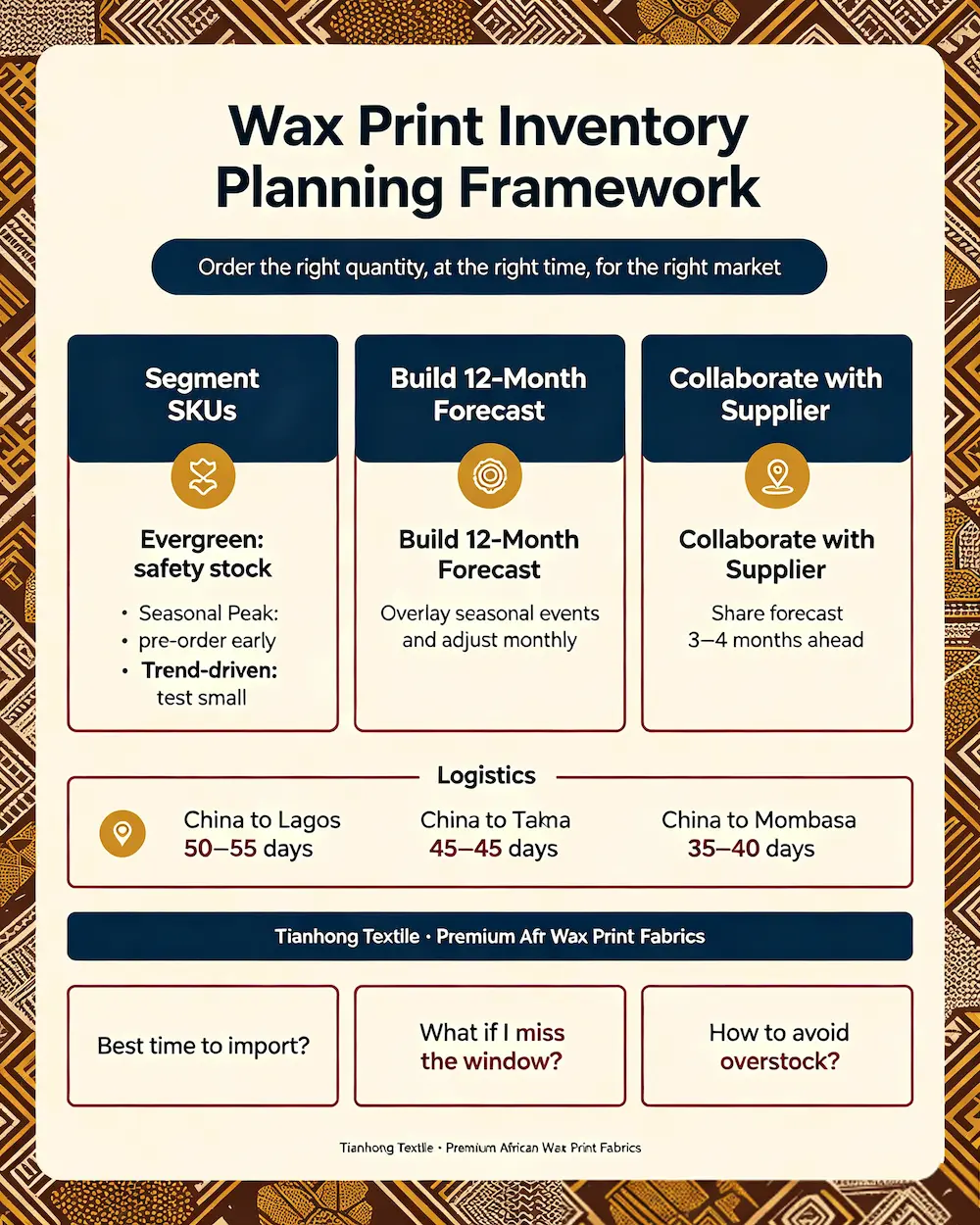
Beyond the seasonal calendar, effective wax print inventory planning requires a simple but disciplined internal process. Here is the framework we recommend to our wholesale partners:
1: Segment Your SKUs by Demand Pattern
2: Build a 12-Month Rolling Forecast
Start simple: export your last 12 months of sales data by week, overlay the seasonal events from the calendar above, and project forward. Even a rough forecast beats no forecast. Adjust monthly as actuals come in.
3: Collaborate Early with Your Supplier
Leading suppliers like Tianhong Textile offer forecast-sharing arrangements — when you communicate your projected needs 3–4 months out, the factory can reserve production capacity, secure raw cotton at better rates, and deliver on time even during industry-wide peak periods. This is particularly critical given that Tianhong operates 11 printing lines and an annual output of 110 million meters — scale that benefits buyers who plan ahead.
4: Factor in Logistics Lead Times
Always work backward from your target in-market date using the total lead time column. This is a vital component of wax print inventory planning that many first-time importers underestimate.
Frequently Asked Questions (FAQ)
1. When is the absolute best time to import Ankara fabric for maximum profit?
The best time to import Ankara fabric depends on your target market, but for most West African wholesalers, the two highest-return windows are August–September (for Christmas/New Year demand) and October–November (for Ramadan/Eid demand). These periods let you sell into the strongest consumer spending cycles at full margin. If you can only place one large order per year, prioritize the Q4 holiday window.
2. How far in advance should I place my wax print orders?
We recommend placing orders 90–120 days before your target in-market date. This accounts for 30–45 days of sea freight, 7–14 days of customs clearance, and 4–6 weeks of distribution to retailers. Rush orders can sometimes be accommodated within 60 days using faster shipping, but freight costs rise significantly — eating into your margin.
3. What happens if I miss the seasonal ordering window?
Missing the window typically means one of two outcomes: (1) you air-freight a smaller quantity at 3–4× the sea freight cost, or (2) you arrive late to market and compete on discount pricing. Neither is ideal. This is why proactive wax print inventory planning — with calendar reminders keyed to the seasonal events above — pays for itself many times over.
4. How do I manage African wax print seasonal demand when Ramadan/Eid dates shift each year?
Check the Islamic (Hijri) calendar at least 6 months before each cycle. Ramadan moves approximately 10–11 days earlier each Gregorian year. For example, if Ramadan started on March 11 in one year, expect it around March 1 the following year. Many wholesalers also subscribe to trade publications like Textile Insight or follow the International Textile Manufacturers Federation (ITMF) for market intelligence that helps calibrate demand forecasts.
5. What minimum order quantity (MOQ) should I plan for seasonal stock?
This varies by supplier and fabric grade. At Tianhong Textile, we work with wholesalers across a wide range of volumes — from small-batch test orders to full container loads. A reasonable starting point for seasonal inventory is 5,000–10,000 yards per design for entry-level wax prints and 2,000–5,000 yards for premium grades. Discuss your market size with our team, and we will help structure an order that balances unit cost with inventory risk. Reach out via wftianhong@gmail.com or call +86 18953683988.
6. How do I avoid overstocking slow-moving designs?
Use the SKU segmentation framework described above — identify which designs are evergreen versus seasonal versus trend-driven — and set different reorder rules for each. Additionally, start each season with a “test and scale” approach: order a base quantity, monitor sell-through for 2–3 weeks, and place a rapid replenishment order (or not) based on real demand signals rather than guesswork. For more on our customization capabilities and flexible MOQs, visit our products page.
7. Does Tianhong Textile offer custom designs for specific seasonal collections?
Yes. Our in-house design and R&D team — backed by 75 sets of advanced production equipment including 11 rotary and flat-screen printing lines — can develop exclusive patterns tailored to your market’s seasonal preferences. Whether you need a Christmas-themed collection for the Nigerian market or a Ramadan capsule for Senegalese retailers, custom development ensures you are not competing with identical designs from other importers. Contact us to discuss your seasonal collection needs.