

Introduction: Why Manufacturing Technology Defines Fabric Quality
Fabric touches every part of our daily lives — from the clothes we wear to the bedding we sleep in. Yet most buyers never ask a critical question: what happens inside the factory that actually determines how a fabric looks, feels, and lasts?
The answer lies in advanced textile manufacturing. When a mill invests in modern equipment, scientific quality systems, and integrated production chains, the difference shows in every meter of fabric. On the other hand, outdated processes produce inconsistent colors, weaker fibers, and fabrics that fade after a few washes.
At Weifang Tianhong Textile Co., Ltd., over two decades of manufacturing experience demonstrates exactly how technology transforms raw materials into premium textiles. This article breaks down the key manufacturing innovations that create better fabrics — and what buyers should look for when sourcing.
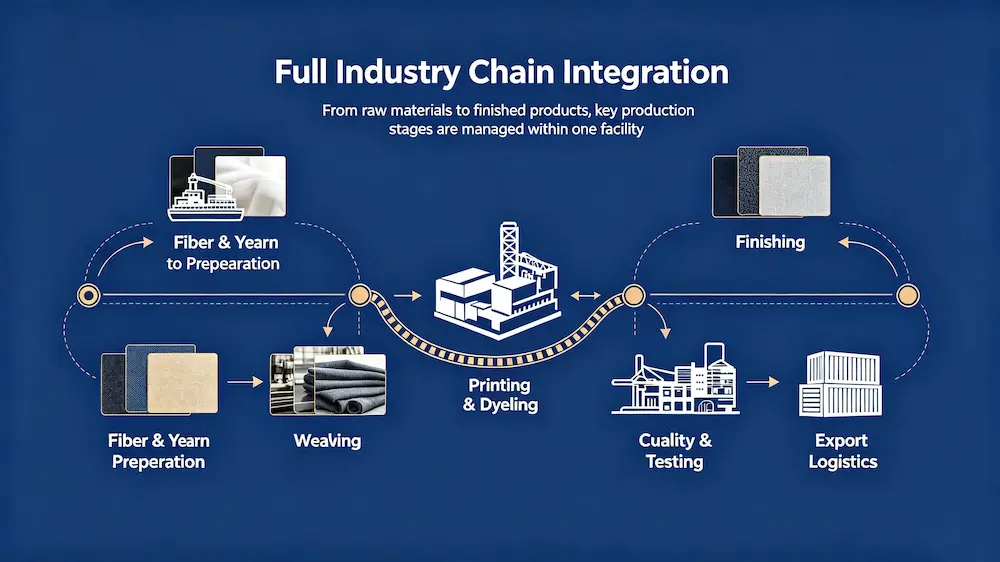
1. Full Industry Chain Integration: One Roof, Total Control
Most textile mills specialize in just one or two stages of production. A weaving mill produces greige fabric. A dyeing house handles color. A separate finishing plant adds the final touch. While this division works, it creates gaps in quality control — every handoff introduces risk.
Tianhong Textile takes a different approach with full industry chain integration. Under one 162,373-square-meter facility, the company manages:
- Fiber texturing and yarn preparation — 8 texturing machines prepare raw fibers
- Weaving — 600 water-jet looms and 150 air-jet looms handle high-speed production
- Printing and dyeing — dedicated printing and dyeing factories with 9 rotary screen and 2 flat screen printing lines
- Finishing and processing — singeing, mercerizing, calendering, and grinding equipment
- Cutting and sewing — 50 cutting units and 300 sewing machines for finished products
- Quality testing — a physical testing laboratory on site
- Export and logistics — in-house sales and shipping coordination
This vertical integration means quality checks happen at every stage — not just at the end. Learn more about Tianhong’s full-chain capabilities.
External insight: According to the International Textile Manufacturers Federation (ITMF), integrated mills consistently outperform fragmented supply chains in both quality consistency and delivery reliability.
2. Reactive Dye Printing vs. Pigment Printing: Choosing the Right Technology
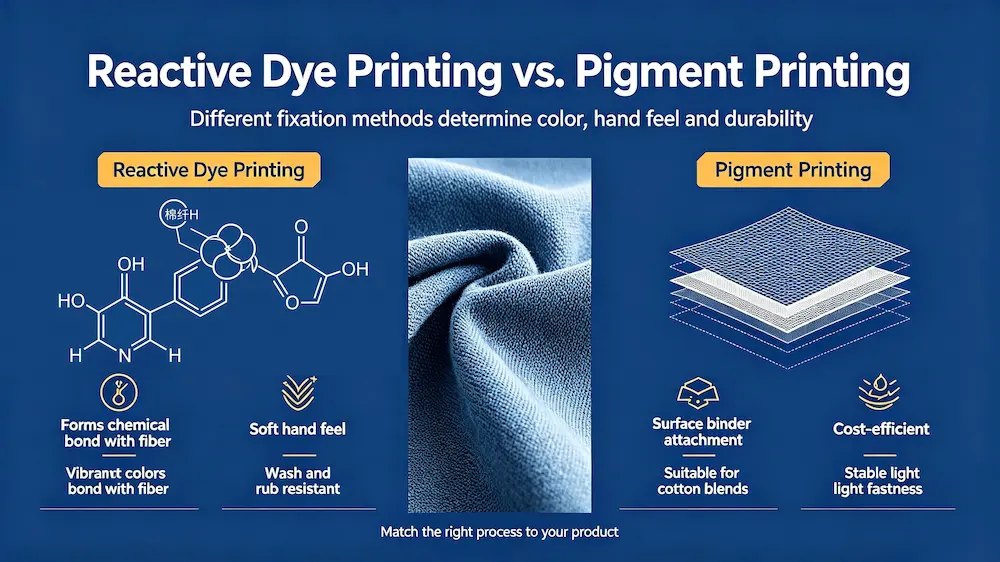
Not all printing methods produce the same result. Advanced manufacturers offer both reactive dye printing and pigment printing — and knowing the difference helps buyers make smarter choices.
Reactive Dye Printing
Reactive dyes form a chemical bond with the fiber — typically cotton. This bond makes the color part of the fabric itself, not just a surface coating. The result?
- Exceptional color fastness (resists washing, sunlight, and rubbing)
- Soft, natural hand feel — the fabric breathes
- Bright, deep colors that do not stiffen the cloth
Tianhong operates 2 pure cotton reactive dye printing lines with an annual capacity of 20 million meters. This technology excels in premium African wax print fabrics, where vibrant, long-lasting color defines the product’s value.
Pigment Printing
Pigment printing applies color to the fabric surface through a binder system. While it offers slightly different characteristics, modern pigment technology has advanced significantly:
- Works on both cotton and polyester blends
- Excellent light fastness for home textiles
- Cost-effective for large-volume production
- Simplified post-print processing (no washing required for some applications)
Tianhong runs 9 pigment printing lines producing 90 million meters annually — ideal for bed sheet fabrics and bedding sets where durability and affordability matter most.
External insight: Research from the American Association of Textile Chemists and Colorists (AATCC) shows that properly executed reactive dye printing can achieve a wash fastness rating of 4–5 (on a 1–5 scale), significantly outperforming basic pigment methods.
3. Advanced Equipment: Why Machinery Matters
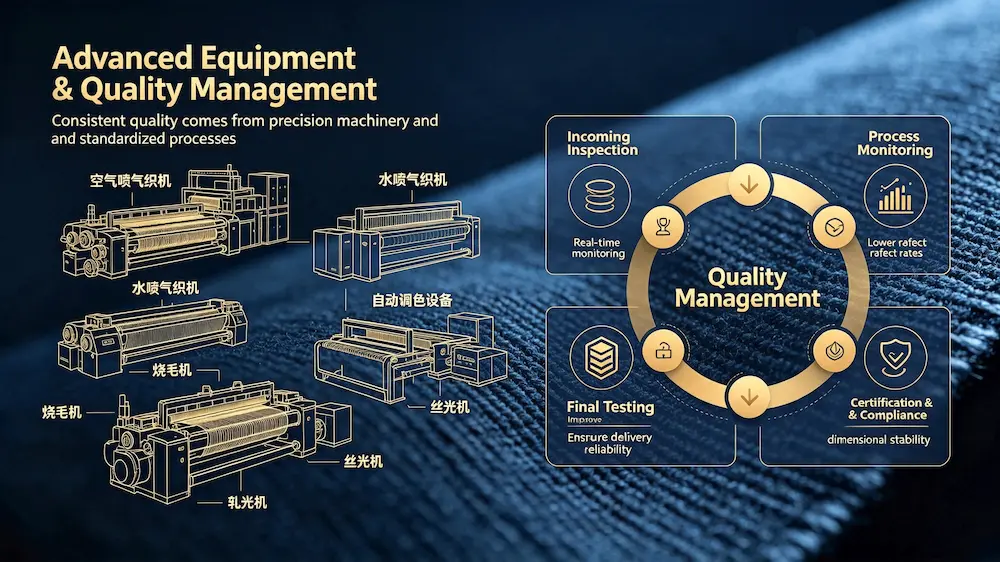
A textile mill’s equipment list tells you more about fabric quality than any marketing brochure. Here is what advanced machinery actually delivers:
High-Speed Precision Looms
Tianhong’s 150 air-jet looms use compressed air to insert weft yarn at extremely high speeds. Compared to older rapier or shuttle looms, air-jet technology produces:
- More consistent weave density — fewer thin spots or irregularities
- Higher production efficiency — shorter lead times for bulk orders
- Cleaner fabric surface — reduced mechanical contact means fewer defects
Meanwhile, 600 water-jet looms handle polyester and synthetic fabrics with similar precision advantages.
Automated Color Mixing
Manual color mixing introduces human error — slight variations between batches create mismatched lots. Tianhong uses automatic pulp blending machines that deliver exact recipe replication every time. For buyers ordering repeat runs months apart, this automation ensures color consistency across shipments.
Precision Finishing Equipment
The finishing stage transforms good fabric into great fabric. Tianhong’s finishing line includes:
- Singeing machines — burn off surface fuzz for a smooth, clean face
- Mercerizing machines — treat cotton with caustic soda under tension to increase luster, strength, and dye absorption
- Calendering machines — apply heat and pressure to create a polished, compact surface
- Stenters (tensioning and setting machines) — control width and dimensional stability
Each machine plays a specific role, and together they produce fabrics that look better, feel softer, and hold their shape longer.
4. Quality Management: Systems, Not Luck
Advanced manufacturing means systematic quality control — not hoping for the best. Tianhong Textile follows a scientific quality management system that touches every production phase:
Pre-Production Quality Gates
Before production even starts, incoming raw materials pass inspection. Yarn strength, fiber length, and color consistency all receive verification. Substandard inputs never reach the line.
In-Process Monitoring
During production, operators monitor key parameters continuously — dye concentration, temperature, tension, and speed. Modern equipment captures data in real time, flagging deviations before they produce defects.
Final Inspection and Testing
A dedicated physical testing laboratory runs standardized tests on finished fabrics:
- Color fastness to washing, rubbing, and light
- Tensile strength and tear resistance
- Dimensional stability (shrinkage)
- Fabric weight and density (GSM verification)
Independent Certification
Tianhong maintains certifications that validate its quality claims. Buyers can view the company’s certificates for independent assurance.
External insight: The ISO 9001 quality management standard — widely adopted across textile manufacturing — emphasizes process-based quality control. Mills that implement systematic quality systems reduce defect rates by an average of 30–50%, according to ISO survey data.
5. Environmental Responsibility: Sustainable Manufacturing at Scale
Modern textile manufacturing must balance production capacity with environmental stewardship. Advanced mills invest in treatment and recovery systems that older factories simply cannot afford.
Tianhong Textile’s facility operates a comprehensive environmental infrastructure:
- Wastewater treatment station — process water from dyeing and printing undergoes treatment before discharge
- Exhaust heat recovery system — captured heat from drying processes feeds back into production, reducing energy consumption
- Desulfurization, denitrification, and dust removal — thermal oil furnace emissions receive multi-stage cleaning
- Solid waste collection and storage — centralized management prevents environmental contamination
These systems do more than meet regulations — they stabilize production. A mill that loses operating permits due to environmental violations cannot deliver on time. Buyers who partner with environmentally compliant manufacturers protect their own supply chains from disruption.
6. From Factory to Finished Product: What Full Service Looks Like
One of the strongest advantages of an integrated manufacturer is the ability to deliver finished goods — not just raw fabric. Tianhong produces 2 million bedding sets annually, transforming its own fabrics into retail-ready products.
This capability eliminates multiple middlemen:
- No separate cutting contractor — 50 cutting units handle everything in-house
- No third-party sewing facility — 300 sewing machines stitch finished products on site
- No packaging outsourcer — automated packing lines prepare goods for export
For wholesale buyers, this translates to shorter lead times, lower total cost, and a single point of accountability. If a quality issue arises, there is only one partner to call.
7. What Buyers Should Look for in an Advanced Textile Manufacturer
After understanding how manufacturing technology shapes fabric quality, here are the concrete factors to evaluate when sourcing:
Tianhong Textile checks every box — and backs it up with over 20 years of production history and a global export footprint spanning Africa, Southeast Asia, and the Middle East.
Frequently Asked Questions
Q: What is the difference between reactive dye printing and pigment printing?
A: Reactive dye printing forms a chemical bond with the fiber (typically cotton), producing vibrant, wash-resistant colors with a soft hand feel. Pigment printing sits on the fabric surface through a binder — it works well for polyester blends and large-volume production, offering good light fastness and cost efficiency. Tianhong Textile operates both technologies to match the right process to each product requirement.
Q: How does full industry chain integration improve fabric quality?
A: Full chain integration means one company controls every production stage — from yarn preparation through weaving, dyeing, printing, finishing, cutting, and sewing. Quality checks occur at each step rather than only at the end. Problems get caught early, and no external supplier introduces variability. The result is more consistent fabric batch to batch.
Q: What types of fabric does Tianhong Textile produce?
A: Tianhong produces wax printed fabrics (100% cotton or polyester, primarily for African markets), polyester bed sheet fabrics, and finished bedding sets (4-piece and 7-piece). The company also offers microfiber fabrics suitable for Middle Eastern abaya production.
Q: Can Tianhong Textile handle custom designs and patterns?
A: Yes. Tianhong supports full customization — from new pattern development and design to production and export. The company also offers copyright protection for client designs, ensuring your unique patterns remain exclusive to your brand.
Q: What is Tianhong’s annual production capacity?
A: Tianhong produces approximately 20 million meters of garment fabric (reactive dye) and 90 million meters of home textile fabric (pigment printing) per year, plus 2 million finished bedding sets. The facility spans 162,373 square meters with 75 major production equipment sets.
Q: How does advanced equipment affect fabric hand feel and durability?
A: Advanced finishing equipment — including singeing machines (removing surface fuzz), mercerizing machines (increasing luster and strength), and calendering machines (creating smooth, polished surfaces) — directly improves how fabric feels and lasts. Automated controls ensure these processes run at precise parameters every time, eliminating the variability of manual operation.
Q: Does Tianhong Textile export globally?
A: Yes. Tianhong exports to Africa, Southeast Asia, the Middle East, and markets worldwide. The company manages export logistics in-house, simplifying the purchasing process for international buyers.
Conclusion: Better Manufacturing, Better Fabric, Better Business
Advanced textile manufacturing is not about having the newest machines for the sake of it. It is about what those machines — and the systems around them — deliver to buyers: fabrics with consistent color, superior hand feel, reliable durability, and on-time delivery.
When you source from a manufacturer like Tianhong Textile, you partner with an integrated operation that controls quality from raw fiber to finished product. That control translates directly to the fabric on your shelves — and the satisfaction of your customers.
Ready to explore how advanced manufacturing can serve your textile needs? Contact Tianhong Textile today to discuss your requirements.