

In textile manufacturing, few technical choices impact end-product quality as profoundly as the printing method. Among the available options — pigment, disperse, acid, and vat — reactive dye printing stands apart as the gold standard for natural fibers like cotton, linen, and viscose. Its defining advantage? Colors that become part of the fabric itself, rather than merely sitting on the surface.
In this article, we explain the chemistry behind reactive dye printing, break down the multi-step production process, compare it head-to-head with pigment printing, and show why it matters for buyers of garment and home textiles.
1. The Chemistry: Why Reactive Dyes Bond, Not Just Coat
To understand why reactive dye printing produces unmatched wash fastness, you have to go down to the molecular level.
1.1 Covalent Bonding: Color as Part of the Fiber
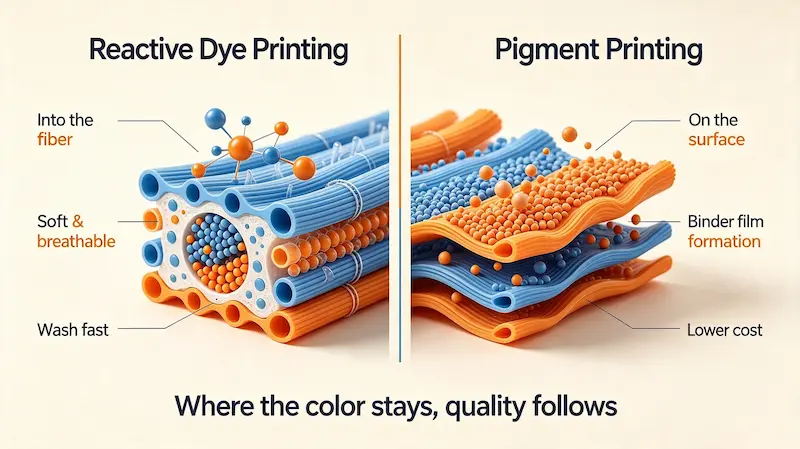
Cellulose fibers — cotton, linen, viscose, bamboo — contain abundant hydroxyl groups (-OH) along their molecular chains. Reactive dye molecules are engineered with a reactive group (typically a chlorotriazine or vinyl sulfone structure) that, under alkaline conditions and heat, forms a covalent bond with these hydroxyl groups.
A covalent bond is the strongest type of chemical bond in organic chemistry — the same type that holds water molecules and DNA together. When a reactive dye molecule forms this bond with a cellulose fiber, the color is chemically locked into the fabric’s molecular structure.
1.2 Why This Matters for Commercial Textiles
The implication for garment and home textile manufacturers is straightforward:
- Wash fastness: Covalently bonded dyes do not wash out. A reactive-printed cotton bedsheet will retain its vibrancy after 50+ industrial wash cycles, while a pigment-printed equivalent will show noticeable fading after 20–30 washes.
- Rub fastness: Because the dye is inside the fiber, not on top of it, reactive prints resist crocking (color transfer due to rubbing) — critical for garments worn against skin and home textiles in daily use.
- Light fastness: The molecular integration provides superior resistance to UV degradation compared to surface-bound pigments (Taylor & Francis).
2. The Reactive Dye Printing Process: Step by Step
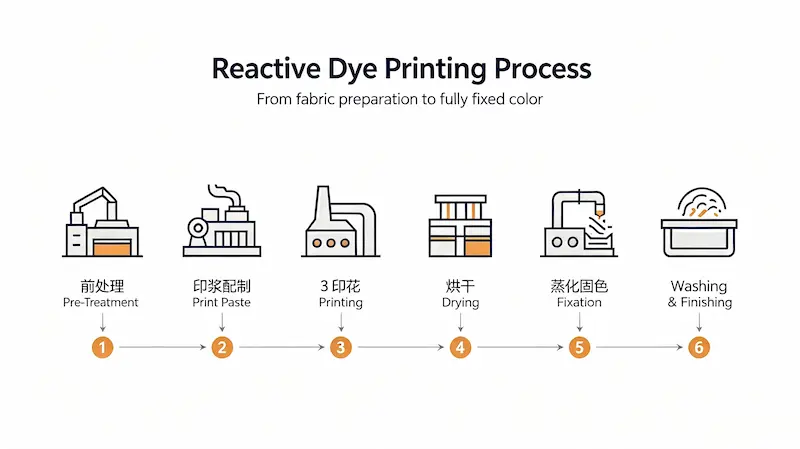
Reactive dye printing is more complex than pigment printing — and this complexity is precisely what delivers the superior result. The standard process involves six distinct stages:
1: Fabric Preparation (Pre-Treatment)
Before printing, the cotton or cellulose fabric undergoes scouring, bleaching, and mercerizing to remove natural waxes, oils, and impurities. This ensures uniform dye absorption. Fabric is then treated with a pre-print solution containing alkali (typically sodium carbonate), urea (a humectant that holds moisture during steaming), and a mild oxidizing agent to prevent dye reduction.
2: Print Paste Formulation
The print paste is a precisely engineered mixture of: reactive dye (the colorant), sodium alginate thickener (a natural seaweed-derived polymer that controls viscosity and prevents dye migration), urea (moisture retention for fixation), resist salt (prevents premature dye-fiber reaction), and alkali (the catalyst for covalent bond formation). The thickener is critical — it must give sharp print definition while washing out completely during the final rinse, leaving zero residue on the fabric.
3: Printing
The paste is applied to fabric via rotary screen printing (high-speed, continuous patterns) or flat screen printing (precision, shorter runs). At Weifang Tianhong Textile, we operate 9 rotary screen printing machines and 2 flat screen printing machines across our production campus, with 2 dedicated reactive dye printing lines capable of 20 million meters of annual output.
4: Drying
Printed fabric passes through a controlled drying chamber at moderate temperatures (80–100°C). This step removes water without triggering the dye-fiber reaction prematurely — if the temperature is too high, the dye may fix unevenly; if too low, moisture remaining in the fabric will cause dye bleeding during the next step.
5: Fixation (Steaming)
This is the critical stage. The dried, printed fabric enters a steamer — a sealed chamber with saturated steam at 102–105°C for 8–15 minutes. Inside this environment, three things happen simultaneously: the urea absorbs moisture and swells the cellulose fibers, the alkali activates the reactive groups on the dye molecules, and the covalent bonds between dye and fiber hydroxyl groups form rapidly (Contrado).
At Tianhong Textile, our long-ring steaming machines ensure uniform steam penetration across the full width of the fabric roll, which is essential for batch-to-batch color consistency.
6: Washing and Finishing
After fixation, the fabric undergoes a multi-stage washing sequence: cold rinse (removes unfixed dye and thickener), hot soaping at 90–95°C (removes hydrolyzed — unfixed — dye that would otherwise bleed during consumer washing), warm rinse, and final cold rinse. The fabric then passes through a tensioning and setting machine (also called a stenter) to restore its dimensional stability and apply any softener or functional finish.
This rigorous washing process is what differentiates a professional reactive printing operation from a low-budget one. Skipping or shortening any wash stage leaves residual unfixed dye on the fabric — which will bleed onto skin or other garments during the first consumer wash.
3. Reactive Dye Printing vs. Pigment Printing: A Detailed Comparison
Pigment printing accounts for over 50% of global textile printing volume due to its lower cost and simpler process. Understanding the trade-offs helps buyers make informed sourcing decisions:
Key takeaway for buyers: If your product competes on quality, durability, and consumer satisfaction — choose reactive dye printing. If your product competes purely on price with short usage cycles, pigment printing may suffice. For brands positioned in the middle market, the incremental cost of reactive printing is typically recovered through reduced returns, better reviews, and higher repeat purchase rates.
At Tianhong Textile, we operate both technologies: 2 reactive dye printing lines (20 million meters/year for premium cotton wax prints and garment fabrics) and 9 pigment printing lines (90 million meters/year for volume-driven polyester applications), allowing us to match the right technology to each buyer’s market positioning.
4. Why Cotton + Reactive Dye = The Winning Combination
Cotton and reactive dyes are a natural synergy. Here is why:
Cotton’s hydroxyl-rich structure provides abundant bonding sites for reactive dye molecules, enabling high dye uptake (typically 70–85% fixation rate for optimized processes). This means less dye waste and more vibrant final color per gram of dyestuff used.
No compromise on natural properties. Because reactive dyes bond at the molecular level without forming a surface film, cotton fabric retains its full breathability, moisture absorption, and soft hand feel — properties that are core to cotton’s value proposition in apparel and bedding markets.
Skin safety. Properly washed reactive-printed cotton carries virtually zero residual unfixed dye. This makes it the preferred choice for baby clothing, underwear, and medical textiles — all segments where skin sensitivity is a critical concern.
Color range. Reactive dyes are available in a vast spectrum from major dye manufacturers (Huntsman, Dystar, Archroma), enabling precise Pantone matching and complex multi-color designs with sharp registration — essential for African wax prints where pattern intricacy is a key selling point.
5. Quality Indicators: How to Evaluate Reactive Printed Fabric
When inspecting reactive-printed fabric — whether from a supplier’s sample or your own QC lab — focus on these key tests:
Wash Fastness (ISO 105-C06): The fabric swatch is washed with a standard detergent at 60°C alongside a multi-fiber witness strip. After drying, both the color change of the printed fabric and the staining of the witness strip are rated on a 1–5 scale. Acceptable: Grade 4.0 minimum. Premium: Grade 4.5–5.0.
Rub Fastness (ISO 105-X12): A dry and wet cotton rubbing cloth is moved back and forth over the printed surface under controlled pressure. The resulting stain on the rubbing cloth is rated 1–5. Acceptable dry: Grade 4.0. Acceptable wet: Grade 3.0–3.5. Anything lower indicates inadequate post-print washing.
Light Fastness (ISO 105-B02): The printed fabric is exposed to a xenon arc lamp alongside Blue Wool standards. After exposure, the degree of fading is rated 1–8. For upholstery, curtains, and outdoor applications: Grade 5.0 minimum. For apparel and bedding: Grade 4.0 minimum.
Hand Feel: While subjective, a reactive-printed cotton fabric should feel indistinguishable from an unprinted control of the same base cloth. Any stiffness or “boardy” feel suggests thickener residue from insufficient washing.
Cross-Section Microscopy (Optional): For the technically inclined — a cross-section of a reactive-printed fiber under a microscope will show dye penetration into the fiber core. Pigment-printed fiber cross-sections will show a distinct ring of pigment-binder on the fiber surface with an undyed core. This is the definitive visual proof of the difference between “in the fiber” and “on the fiber.”
6. Environmental Considerations
Reactive dye printing has a higher environmental footprint than pigment printing in terms of water and energy consumption — a fact buyers should acknowledge rather than ignore. However, modern factories mitigate this through several measures:
Effluent Treatment: At Tianhong Textile, our on-site wastewater treatment stations process all washing effluent before discharge, removing hydrolyzed dye residues, alkali, and thickener degradation products. This is supported by exhaust heat recovery systems that capture thermal energy from hot wastewater and reuse it to pre-heat incoming fresh water, reducing overall energy consumption.
High-Fixation Dyes: Modern bifunctional reactive dyes (combining monochlorotriazine and vinyl sulfone reactive groups) achieve fixation rates above 85%, meaning less dye is hydrolyzed and wasted per production run — reducing both dye cost and effluent load.
Urea Reduction: Newer printing formulations can reduce urea usage by 30–50% compared to traditional recipes, significantly lowering the nitrogen load in wastewater — a key parameter for environmental compliance.
For buyers serving markets with strict environmental regulations (EU REACH, ZDHC, OEKO-TEX Standard 100), Tianhong Textile’s integrated environmental management system — covering wastewater, exhaust gas (desulfurization and denitrification for thermal oil furnaces), and solid waste collection — provides a critical compliance backbone.
7. Frequently Asked Questions (FAQ)
Q: What is the difference between reactive dyeing and reactive printing?
A: Reactive dyeing is a solid-color (all-over) process where the entire fabric is immersed in a dye bath. Reactive printing applies dye selectively to create patterns, designs, or motifs on the fabric surface. Both use the same chemical bonding mechanism, but printing requires thickeners to control pattern definition and uses significantly less water since only the printed area carries dye.
Q: Can reactive dyes be used on polyester fabric?
A: No. Reactive dyes bond specifically with hydroxyl (-OH) groups found in cellulose fibers (cotton, linen, viscose, bamboo) and amino (-NH2) groups in protein fibers (silk, wool). Polyester lacks these functional groups entirely. For polyester, disperse dyes are the standard — they work through a completely different mechanism (diffusion into the fiber under high heat). If your product is 100% polyester or a polyester-rich blend, ask your supplier about pigment or disperse printing options.
Q: How many washes can reactive-printed fabric withstand before fading?
A: A properly processed reactive-printed cotton fabric with a wash fastness rating of Grade 4.0–5.0 will show no visible fading after 50+ standard home wash cycles at 40–60°C. Industrial laundries at higher temperatures (75–90°C) will accelerate fading, but reactive prints still outperform pigment prints by a factor of 2–3x in accelerated wash testing.
Q: Why does reactive-printed fabric feel softer than pigment-printed fabric?
A: Pigment printing applies a binder resin that forms a thin polymer film on the fabric surface to glue pigment particles in place. This film stiffens the fabric, reduces breathability, and creates a perceptible “hand” difference. Reactive printing leaves zero residue — the thickener used during printing (sodium alginate) is fully washed out during the final rinse. The fabric retains its original softness, which is why premium garment and bedding manufacturers specify reactive printing in their sourcing briefs.
Q: Is reactive dye printing more expensive than pigment printing?
A: Yes — typically 20–40% more expensive per meter, depending on design complexity, color count, and order volume. The cost difference comes from: additional processing steps (steaming, multi-stage washing), higher dye cost per kilogram, higher energy consumption (steam generation, hot water for washing), and higher water consumption. However, for brands positioned above the budget segment, the cost difference is often recovered through higher retail pricing, lower return rates, and stronger brand reputation for quality.
Q: How can I verify that fabric is reactive-printed and not pigment-printed?
A: Three practical methods: (1) Burn test: A reactive-printed area burns the same as unprinted fabric. A pigment-printed area may produce a slightly different flame color or odor due to the binder resin. (2) Rub test: Rub the printed surface firmly 20 times with a damp white cloth. Reactive: minimal to no color transfer. Pigment: visible color transfer in most cases. (3) Hand feel: Feel the printed vs. unprinted areas of the same fabric. Reactive: identical feel. Pigment: printed area feels stiffer or smoother. For lab-grade verification, request ISO 105-C06 wash fastness test results from your supplier.
Q: What is the minimum order quantity (MOQ) for reactive-printed fabric?
A: MOQ varies by supplier. At Tianhong Textile, our reactive dye printing lines are set up for mid-to-large volume orders — typically 2,000–5,000 meters per design, depending on color count and design complexity. For smaller test orders, we recommend starting with our pigment printing lines for sampling, then scaling up to reactive printing for bulk production. Contact our trade team via our contact page for a customized quotation.
Q: Does reactive dye printing work for African wax print designs?
A: Yes — and in fact, high-quality African wax prints are almost exclusively reactive-printed on cotton. The deep, vibrant colors, sharp pattern registration, and color fastness expected in African wax print markets (West Africa, Central Africa) can only be achieved through reactive printing. Pigment-printed African prints tend to look dull, feel stiff, and fade quickly — which damages brand reputation in these discerning markets. At Tianhong Textile, our 20-million-meter annual reactive printing capacity is specifically deployed for premium cotton wax prints and garment fabric applications. Browse our African wax print collection for reactive-printed options.
8. Conclusion
Reactive dye printing represents the intersection of chemistry and craftsmanship in textile manufacturing. The covalent bond between dye and fiber is not a marketing claim — it is a measurable, testable, and repeatable chemical reality that translates directly into consumer benefits: clothes that stay vibrant, bedding that feels soft wash after wash, and patterns that refuse to fade.
For garment brands, home textile wholesalers, and fabric importers, the decision to specify reactive printing is fundamentally a decision about where your product sits in the market. If you compete on quality, durability, and consumer trust — reactive dye printing is not an upgrade. It is the standard.
Weifang Tianhong Textile Co., Ltd. operates both reactive and pigment printing lines at industrial scale — 20 million meters of reactive and 90 million meters of pigment annually — across a 162,373-square-meter integrated manufacturing campus. Whether you need premium cotton wax prints with Grade 4.0+ color fastness or cost-optimized polyester prints for volume markets, our team can match the right technology to your commercial requirements.
Contact our trade team to discuss your next order or request fabric swatches for evaluation.